
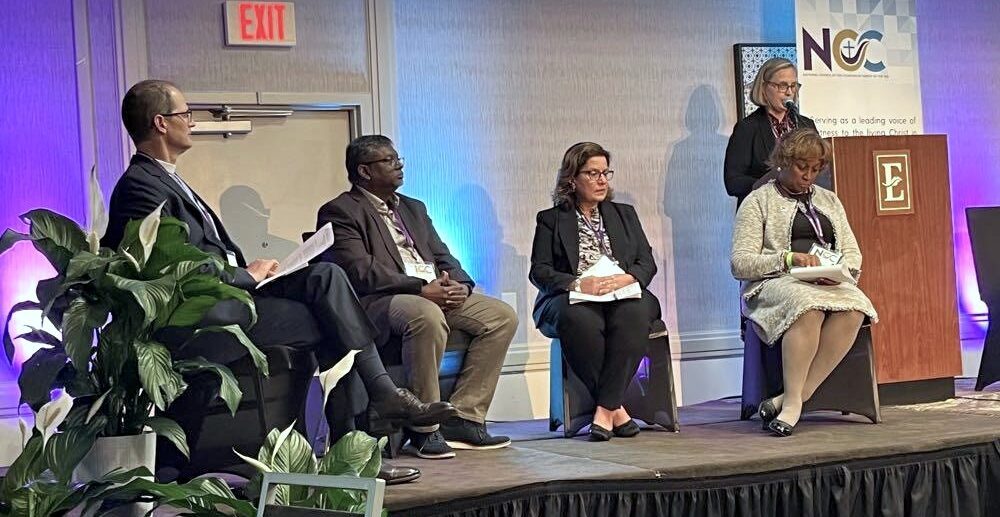
Issues surrounding Artsakh and the plight of its Armenian population were prominently featured during the 2023 “Christian Unity Gathering” of the National Council of Church of Christ in the U.S.A., held in Nashville, TN, October 9-11.
The delegation from the Eastern Diocese of the Armenian Church of America, under the guidance of Diocesan Legate and Ecumenical Director Archbishop Vicken Aykazian, played a leading role in the discussion. Yn. Arpi Kouzouian, of Holy Trinity Church in Cambridge, MA, represented the Eastern Diocese, along with Raffi Balian of Washington, DC (co-convenor of the NCC’s Christian Unity Convening Table) and St. Nersess Seminarian Dn. Garen Hamamjian.
The Christian Unity Gathering is a three-day convocation of clergy, advocates, and activists from various Christian traditions who gather to envision ways to collaborate on critical issues of the day. On the agenda for this year’s gathering was a session on “Religious Nationalism and the Persecution of Religious Minorities in Global Contexts, with a Focus on the Situation of Christians in India and Artsakh.
Yn. Arpi Kouzouian served as a panelist in that session. She gave an overview of the situation in Artsakh, highlighting the history and roots of the conflict, and describing recent atrocities at the hands of the genocidal regime of Azerbaijan, which have resulted in the current crisis of “ethnic cleansing” of the native Armenians from Artsakh.
“Despite many media reports stating otherwise,” stressed Yn. Kouzouian, “this exodus was not voluntary. It was a forced deportation: an ethnic cleansing—the next step in continuing the Genocide against the Armenian people.”
Crisis, Trauma, and Resilience
When asked how the situation in Artsakh has affected the diasporan community, Yn. Kouzouian responded: “Today, our Armenian nation is in the midst of a humanitarian crisis. Simply put, the entire Armenian nation is traumatized because what is happening in Artsakh and Armenia today is not just happening to the souls in that region, but to all Armenians in every corner of the world. We are numb, paralyzed by trauma, fear, and depression, yet keenly aware that Azerbaijan is not finished, and that mainland Armenia is their next target.”
Kouzouian also spoke of the impact of the crisis on the youth and young adults of Armenian-American communities. “Our young people are struggling with so many aspects of the situation, including questioning humanity, wondering how we can live in a world that allows such things to happen.”
She also addressed the inter-generational trauma experienced by the youth and young adults of our communities. “We grew up hearing about the Armenian Genocide, and although it didn’t happen to us directly, we grew up feeling the persecution and it has framed who we are. Despite our hope that the sanctification of our Armenian martyrs in 2015 on the 100th anniversary of the Armenian Genocide would help change our narrative from Armenians being victims to victors, we continue to pass this trauma on to our children, who thanks to social media, are experiencing today’s trauma firsthand.”
She continued by sharing that our hope, however, is also in our young people. “They are resilient and come from a long line of resiliency. They are moved to action. Many of the grassroots efforts of humanitarian aid have been started by the young adults in our communities. They are mobilizing and utilizing social media to spread awareness and solicit aid. Our hope lies in their spirit of resilience.”
Yn. Kouzouian concluded by thanking the NCC for its continued support of the Armenian people. She also stressed: “Now more than ever, we must dedicate time for purposeful prayer in our communities, share information on social and other media to raise awareness, contact our elected representatives at all levels of government to inform them and ask them to take immediate action to protect the people and their cultural heritage, support humanitarian efforts that provide aid to the displaced refugees, and collaborate with faith groups locally, regionally, nationally, and globally to amplify the message of peace and justice.”
The session’s other panelists included moderator the Very Rev. Dr. Edward Thompson of the NCC Theology Task Force; Rev. Dr. Chakravarthy Zadda of the American Baptist Churches U.S.A., who brought awareness of the religious persecution taking place in Manipur, India); and Rev. Dr. Angelique Walker-Smith, World Council of Churches President from North America, who outlined how the WCC responds to humanitarian crises, including those taking place in India and Armenia.
The National Council of Churches brings together 37 member communions and some 30 million Christians.
Following the NCC’s “Christian Unity Gathering,” Yn. Arpi Kouzouian attended the Governing Board meeting held October 11-12 in Nashville. As a newly elected member-at-large of the Governing Board, she was present to witness the passing of the NCC’s strongly-worded “Statement on the Situation of Armenians in Nagorno-Karabakh.”
Excerpts of that statement appear below. To read the full statement, click here. Click here to view photos.
* * *
NCC’s Statement on the Situation of Armenians in Nagorno-Karabakh
The Armenian Genocide (1915-1923) was the first genocide of the 20th Century. Over 1 million Armenians, whose forbears comprised the first nation to become Christian, were systematically killed, and hundreds of thousands more were displaced and roamed the earth as refugees until they found safe havens in other countries, including the United States. Many who came to the US, as well as their descendants, continued to practice their faith in the Armenian Orthodox Church, one of the 37 member communions of the National Council of Churches. It is out of this relationship with our Armenian brothers and sisters that the NCC has long stood with the Armenian community in condemning the historic genocide, in urging its recognition by the global community, and in being in solidarity with the Armenian people.
These actions include responding to the suffering of the Armenians today at the hands of Azerbaijan in Nagorno-Karabakh, also known as Artsakh. Indeed, due to actions by the Azerbaijani government, many today fear that another genocide of the Armenian people is taking place. While genocide typically takes place methodically over months and years, the NCC believes we may indeed be witnessing a continuation of genocide against the Armenian people, one that is borne of supremacy as in other genocides, but rather than consume the perpetrators in swift and orchestrated killing, unfolds over the long term in disparate acts of ethnic cleansing. As we have noted with alarm the illegal, humanitarian blockade of the region and the destruction of critical infrastructure, and observe the steady stream of refugees flowing through a single geographic conduit to safety, can we not assume this is in fact what is happening?
The crime that became known as “genocide” did not always have a name…. In recent years, the NCC has responded to the challenges that seek to further victimize and erase the existence of the Armenian people, their history, and their culture.
Today, as we look aghast at the renewed trauma and threat of genocide against the Armenian people, the NCC again resolves to continue facilitating humanitarian assistance, providing spiritual sustenance, and conducting political advocacy to end this conflict and the very real threat of genocide.
October 13, 2023
Washington, DC