
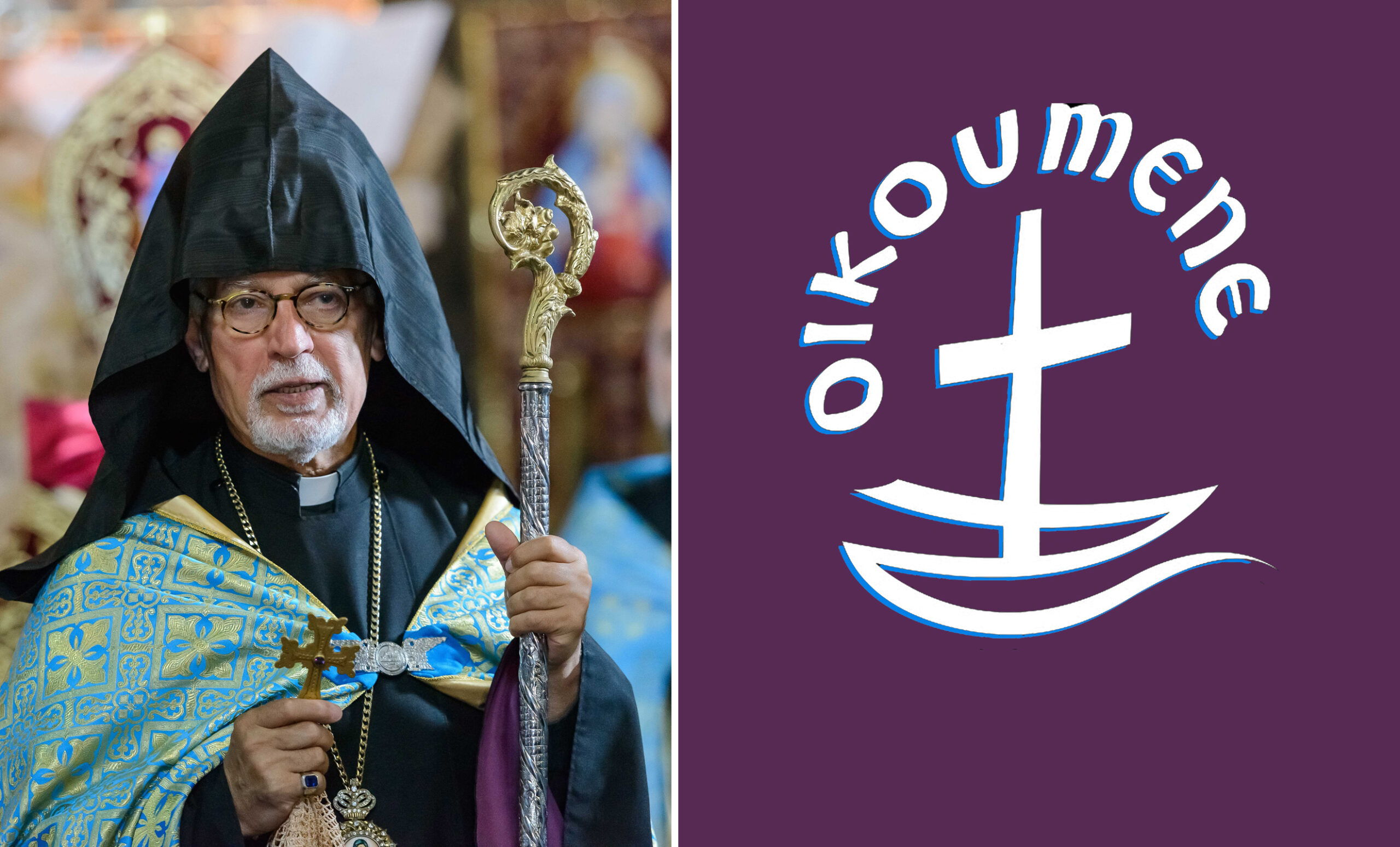
The World Council of Churches issued a strong statement of solidarity with Armenia and Artsakh on November 13, 2020, in the aftermath of the Artsakh war.
Archbishop Vicken Aykazian, the Diocesan Legate and Ecumenical Director of the Eastern Diocese, called the statement “an extremely powerful testimony from our sister churches and the worldwide ecumenical community.”
Archbishop Aykazian, a longtime board member of the WCC, was instrumental in this and two previous statements of solidarity from the international ecumenical organization, issued during the war.
The November 13 WCC statement makes special mention of the need to preserve and protect Armenian holy sites, and condemns the use of chemical weapons, and threats of genocide against the Armenian people.
It concludes: “We call urgently upon all members of the international community to join in supporting efforts for the protection of such holy sites, for the return in safety and dignity of all refugees and displaced people, for protection of the Armenian people from the threat of genocide, for a lasting peace founded on justice and human rights for the people of Nagorno-Karabakh/Artsakh and the wider region, and to refrain from instigating or encouraging antagonism, conflict and injustice.”
Read the whole WCC statement below, and on the organization’s website.
* * *
Statement on the Nagorno-Karabakh Conflict
Executive Committee / 13 November 2020
But let justice roll down like waters, and righteousness like an ever-flowing stream. (Amos 5:24)
The executive committee of the World Council of Churches (WCC), meeting by video conference on 9-13 November 2020, is gathered at a pivotal and acutely painful moment for the people of the land of Nagorno-Karabakh/Artsakh and for all Armenian people, following the announcement of an agreement between the leaders of Azerbaijan, Armenia and Russia to bring an end to six weeks of intense armed conflict. We make an appeal for an end to the bloodshed and destruction this conflict has brought.
We join with His Holiness Karekin II, Supreme Patriarch and Catholicos of All Armenians, in praying for wisdom, unity and calm. We grieve with all those who have suffered terrible losses not only in the renewed fighting since 27 September, but throughout the long history of the struggle for self-determination in the region, entrenching antagonism more deeply with each precious life lost.
We stand in solidarity with the Armenian communities that are threatened by the renewal of the genocide against their people, particularly in light of the egregious comments made by Turkish President Erdogan vowing to “fulfil this mission, which our grandfathers have carried out for centuries, in the Caucasus region” and in light of Turkey’s role in the current conflict. The WCC condemns any such threats, explicit or implicit, and the actions of those who have insinuated themselves in the conflict and exacerbated its violence, including by supplying internationally-banned weapons, sending mercenaries and jihadists from Syria and elsewhere, and seeking to turn it into a religious conflict. The WCC condemns the use of chemical weapons and cluster munitions, the targeting of civilians, hospitals and public infrastructure, and all other war crimes, beheadings, torture and other atrocities witnessed in the past weeks.
Furthermore, we appeal for respect for the holy sites and cultural heritage of Nagorno-Karabakh/Artsakh, though the repeated shelling of the Ghazanchetsots Cathedral in Shushi on 8 October and the numerous reports being received of other more recent desecrations indicate a different reality. We urge UNESCO to take all possible and appropriate measures to protect these sites.
We call urgently upon all members of the international community to join in supporting efforts for the protection of such holy sites, for the return in safety and dignity of all refugees and displaced people, for protection of the Armenian people from the threat of genocide, for a lasting peace founded on justice and human rights for the people of Nagorno-Karabakh/Artsakh and the wider region, and to refrain from instigating or encouraging antagonism, conflict and injustice.
We lift up and accompany the continuing ministry and witness of the churches of the region, and pray that the church leaders may be given strength and wisdom to guide their people through this crisis.
One Comment
Pingback/Trackback
February 17, 2021 at 9:28 am
A Statement of solidarity with Artsakh from the World Council of Churches – Armenian Genocide in Azerbaijan