
In an urgent announcement this week, the Mother See of Holy Etchmiadzin responded to renewed threats against the Armenian Christian heritage in Artsakh.
The announcement of February 8, 2022, addressed remarks made earlier in the week by Azerbaijan’s Minister of Culture, who told a press briefing that his government would be forming a “working group of experts in Albanian history and architecture” tasked with removing “the false traces written by Armenians on Albanian religious temples.”
The minister’s statement referred to a theory categorically rejected by historians—but that has recently become prominent in Azerbaijan—that Armenian inscriptions in churches on Azerbaijani territory are not original, but were late additions to structures built under Caucasian Albania, an ancient Christian kingdom that ruled part of the territory that is today Azerbaijan.
The Mother See responded with a strong condemnation of this Azeri effort, calling it “cultural genocide,” “vandalism,” and “an uncivilized act against humanity, which shows evidence of ongoing, underlying enmity and hatred towards Artsakh and the Armenian people.”
“The Armenian identity of the Christian holy places now under the oversight of Azerbaijan is a scientifically established reality, and not an object of debate,” Etchmiadzin stated. (Click the following links to read about Etchmiadzin’s announcement, in English and Armenian.)
Support for Preserving Artsakh’s Armenian Heritage
Beyond inciting outrage among Armenian authorities, the prospect of vandalizing Armenian treasures in Artsakh also caused grave concern among international scholars and activists. “We are deeply concerned by Azerbaijan’s plans to remove Armenian Apostolic inscriptions from churches,” wrote Nadine Maenza, who chairs the U.S. Commission on International Religious Freedom. “We urge the government to preserve and protect places of worship and other religious and cultural sites.”
In subsequent days, reports have surfaced suggesting that the government of Azerbaijan may be distancing itself from the original statement of its Minister of Culture. According to the Internet journal Eurasia.net, a subsequent statement from the ministry emphasized that “Azerbaijan has always been respectful of its historical and cultural heritage, regardless of religious and ethnic origin.” Eurasia.net reports that “The new statement reaffirmed that ‘a working group has been set up to study this heritage’ and that ‘[s]hould any falsifications be identified, they will be documented with the participation of international experts and presented to the international community.’ But it did not mention removing any Armenian traces.”
The attempt to “walk back” the initial inflammatory statement may be a sign that international pressure is having an effect.
Nevertheless, His Holiness Karekin II, the Supreme Patriarch and Catholicos of All Armenians, has directed the world’s Armenian Church dioceses to take up the matter with their respective governments and humanitarian organizations.
Bishop Daniel, Primate of the Eastern, responded to Catholicos Karekin II’s request by sending a letter to U.S. President Biden, as well as other governmental officials. “As Armenian-Americans,” he wrote, “our community joins the Mother See of Holy Etchmiadzin in asking all nations concerned with the settling of the Karabagh conflict, especially the co-chair nations of the OSCE Minsk Group, as well as religious organizations and international bodies of experts, to condemn this attempt of ‘cultural genocide’ by Azerbaijan, in the hope of preventing this and similar acts of vandalism against Armenian Christian monuments.”
The full letter appears below. Through the outreach of the Primate and Diocesan Legate Archbishop Vicken Aykazian, other leaders of the Christian Orthodox and Ecumenical communities will be writing in support of the urgent need to ensure the preservation and integrity of Artsakh’s Armenian heritage.
* * *
President Joseph R. Biden
The White House
Dear President Biden:
I am writing as Chief Bishop of the Eastern Diocese of the Armenian Church of America, to express the concern and outrage of our community over recent announcements from the government of Azerbaijan, that signal its official plans to desecrate Armenian Christian monuments, and erase evidence of their Armenia origin, in the region of Nagorno-Karabagh.
As you know, Nagorno-Karabagh has been the subject of a territorial dispute between the Republic of Armenia and Azerbaijan, since the period before the fall of the Soviet Union. Karabagh (or Artsakh, as it is known in Armenian) has long been a majority-Armenian region, considered part of historic Armenia since antiquity. For 30 years, starting in the early 1990s, Karabagh was governed as an independent Armenian republic. But in the fall of 2020, Azerbaijan launched a cynical surprise attack on the region, conquered large portions of it through force of arms, and incorporated these lands into its own territory. That event displaced thousands of Armenians from their homes, and left hundreds of Armenia monuments at the mercy of Azeri military forces.
This week, the Azeri Minister of Culture gave a press briefing in which he announced his government’s intention to proceed with another anti-Armenian initiative. According to this announcement, in Azerbaijan a “working group of experts in Albanian history and architecture” has been formed, whose goal is to remove “false traces [sic] left by Armenians” from Albanian religious temples.
The Culture Minister’s statement references a theory, which has become prominent in Azerbaijan—but is categorically dismissed by mainstream scholars and historians—that Armenian inscriptions in churches on Azerbaijani territory are not original, but were late additions to churches built under Caucasian Albania, an ancient Christian kingdom that ruled part of the territory that is today Azerbaijan.
To the contrary, however, the Armenian identity of these Christian holy places has never before been in question. It is a reality firmly established by scholars across the globe, and cannot be considered a topic of debate in objective scholarly circles.
The supreme authority of the worldwide Armenian Church, the Mother See of Holy Etchmiadzin, has strongly condemned this initiative of the Azerbaijani authorities, calling it “an uncivilized act against humanity, which demonstrates an ongoing, underlying enmity and hatred towards Artsakh and the Armenian people.”
As Armenian-Americans, our community joins the Mother See of Holy Etchmiadzin in asking all nations concerned with the settling of the Karabagh conflict, especially the co-chair nations of the OSCE Minsk Group, as well as religious organizations and international bodies of experts, to condemn this attempt of “cultural genocide” by Azerbaijan, in the hope of preventing this and similar acts of vandalism against Armenian Christian monuments.
In the days following the announcement, the Azeri government seems to be distancing itself from the explicit statement of its Culture Minister. Perhaps this is a positive sign that pressure from the international community—which immediately expressed outrage at the minister’s initial announcement—is working. However, the danger to the Armenian heritage—and to Armenian lives—in Azeri-controlled territories of Karabagh remains urgent.
Mr. President, we would welcome the opportunity to meet and discuss this matter further. Most of all, we appeal to you to make your condemnation of this outrageous policy known to the public, and especially to the government authorities of Azerbaijan.
Thank you for your consideration and attention to this urgent matter.
With my prayers,
Bishop DANIEL
Primate
* * *
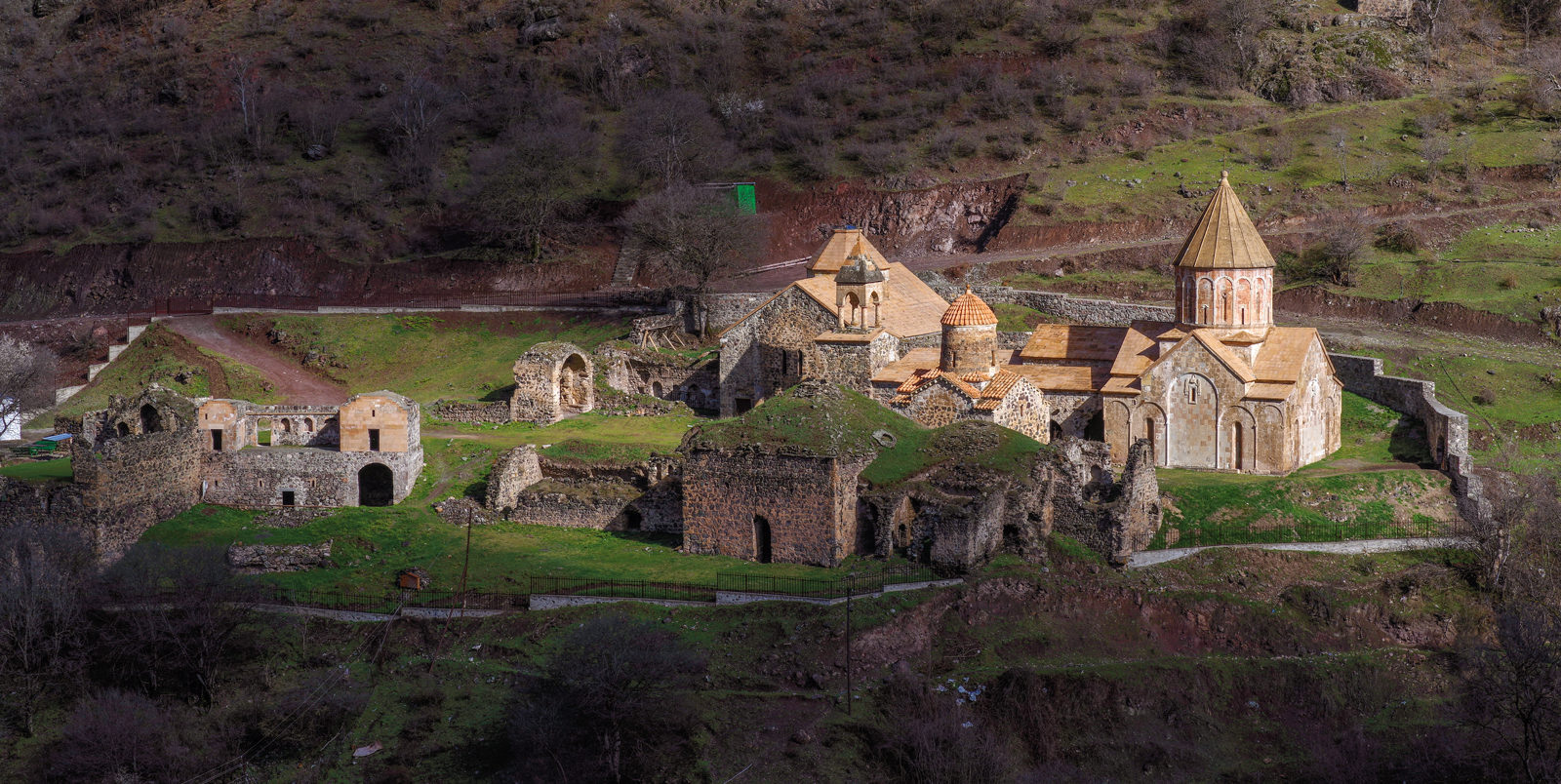
Above: The magnificent Armenian monastery of Dadivank—built in the 9th to 13th centuries, with foundations in the Apostolic Age—is one of the ancient Armenian treasures of Artsakh now endangered in the aftermath of the Artsakh war. It continues to exist today, precariously, under the protection of Russian peacekeepers. But following the withdrawal of Armenian forces from the region in late 2020, international concerns were raised that Dadivank would be subjected to vandalism, desecration, or even utter destruction. Those concerns were renewed with last week’s announcement from the Azeri Ministry of Culture. (Photo by Hawk Khatcherian.)
4 Comments
Pingback/Trackback
February 11, 2022 at 10:43 pm
Letter of Bishop Daniel to President Joseph R. Biden – Armenian Genocide from Azerbaijan
Pingback/Trackback
February 12, 2022 at 12:08 pm
Письмо епископа Даниэла президенту Байдену — Armenian Genocide from Azerbaijan
Pingback/Trackback
February 12, 2022 at 12:16 pm
Letter of Bishop Daniel to President Joseph R. Biden – Armenian Genocide from Azerbaijan
Pingback/Trackback
February 12, 2022 at 12:17 pm
Письмо главы Восточной епархии Армянской церкви США епископа Даниэла президенту Байдену — Armenian Genocide from Azerbaijan