
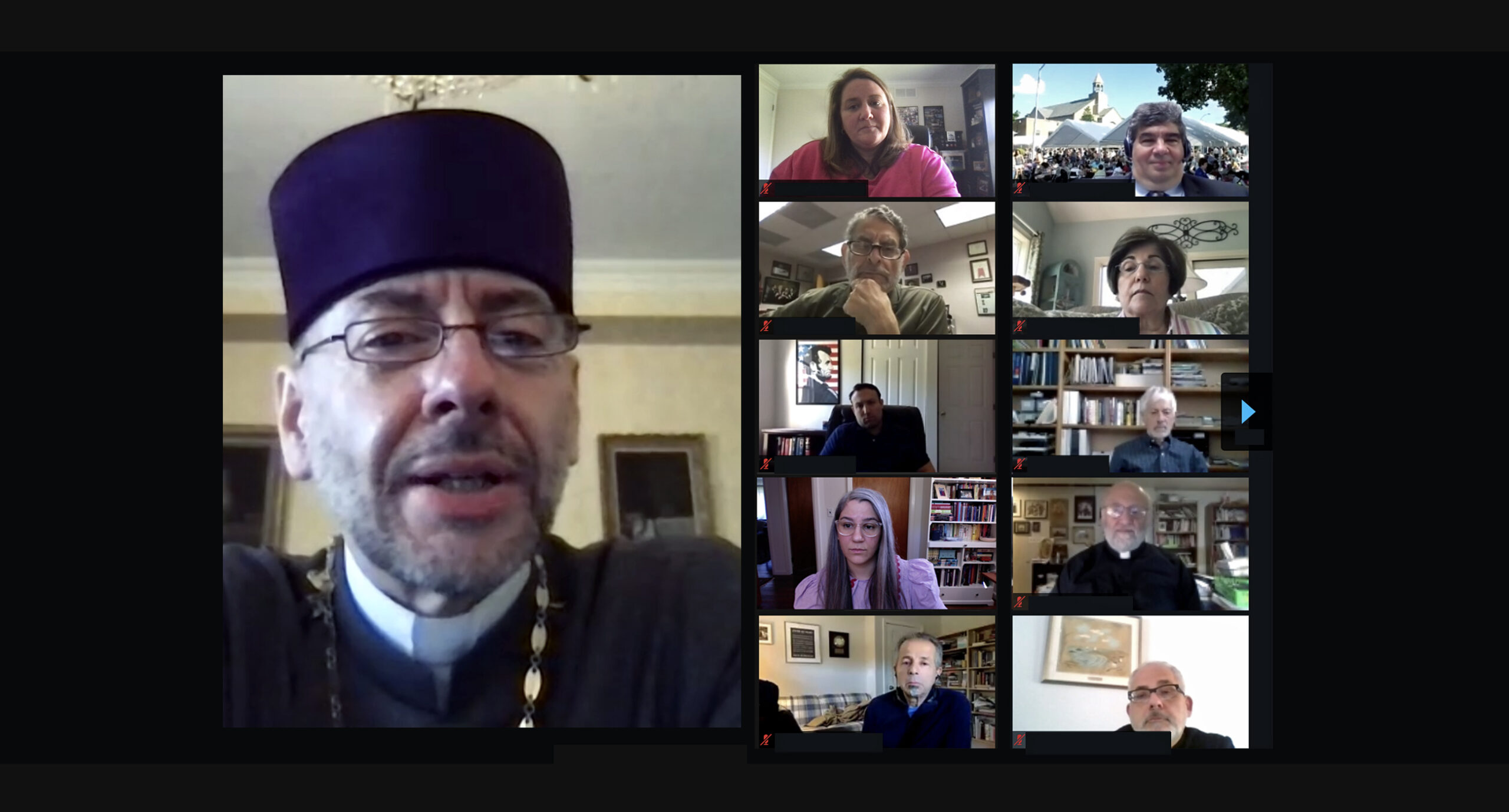
The Eastern Diocese held the main General Session of its 119th Diocesan Assembly as an online gathering, with all attendees participating remotely over the Internet, on Saturday, May 1.
Diocesan Primate Bishop Daniel Findikyan presided over the assembly and delivered his annual formal address. About 150 clergy, Diocesan delegates, and parish council chairs took part in the meeting over the Zoom conference platform.
Gregory Saraydarian (of Holy Martyrs Church, Bayside NY) was elected as Assembly chair, with Alex Tobakbashian (St. Sahag and St. Mesrob Church, Wynnewood, PA) serving as vice chair, and Laurie Bejoian (Holy Translators Church, Framingham, MA) serving as secretary.
Due to the ongoing effects of the COVID-19 pandemic, the 119th Diocesan Assembly maintained the remote format which had also caused the 118th Diocesan Assembly (in January 2021) and an “informational assembly” (September 2020) to be held as virtual events. Voting for Diocesan offices was also conducted online, using a secure platform successfully employed during the 118th Assembly. Diocese staffers Jennifer Morris and Kathryan Ashbahian, of the Youth and Young Adult Ministries department, capably facilitated the online meeting and helped deleigates navigate the system.
The May 1 session was the start of virtual Assembly meetings that will take place throughout the month, including “breakout sessions” on three weekday evenings, and culminating in a final General Session on the evening of Tuesday, May 25.
A Year of Hardship, Endurance … and Hope
Diocesan Primate Bishop Daniel began his annual address to the delegates with welcoming words in Armenian. In the English portion of his address, the Primate quoted the Pauline epistles’ perspective on the perennial human problem of hardship, and its resolution in the unique hope delivered through Jesus Christ: “We rejoice in our sufferings, knowing that suffering produces endurance, and endurance produces character, and character produces hope, and hope does not put us to shame, because God’s love has been poured into our hearts through the Holy Spirit who has been given to us” (Rom 5:3-5).
He went on to say that after more than a year of living under pandemic restrictions, the Diocese was looking ahead to the more complete functioning of churches and facilities. He made reference to a directive he had sent to Diocesan leaders days earlier, which outlined steps to move forward with caution and concern for health and safety.
The Primate applauded parishes for the way they adapted to the 2020 crisis, and how they employed Internet broadcasts to keep parishioners together, informed, and inspired. Nevertheless, he stressed, “the church can only happen face-to-face”; the judicious use of virtual services, for example, cannot replace the active, personal experience of attending the badarak and receiving Holy Communion. Bishop Daniel explained that a Diocesan committee had been formed to guide the faithful in the restoration of active church life.
The Bishop sketched a number of accomplishments of the past year, which were highlights of progress despite the difficulties 2020 presented. Chief among them, he said, were his opportunities as the year progressed to pay personal visits to parishes—often clustering a number of parish visits in a given region within a weeklong period of travel. He mentioned with enthusiasm his visits to the Diocesan churches in New England, the New York/New Jersey region, April’s long visit to the Midwest region, and within the past few days a trip to the Minneapolis community.
Another achievement of the past year, he said, was the reconfiguration of the directorship of the Diocese’s Krikor and Clara Zohrab Information Center into a university fellowship, in collaboration with Fordham University’s Orthodox Christian Studies Center.
The Primate also listed developments in creating a Deacons’ Fellowship in the Eastern Diocese; the ongoing work of the Diocese’s Commission on Women’s Ministry; and the ordination of a new priest last April, with additional ordinations coming up in May and June. At the end of this series of ordinations, Bishop Daniel will have consecrated five recent graduates of St. Nersess Seminary as clergymen of Armenian Church.
He also referenced early efforts of a newly-established Diocesan Committee on Racial Social Justice and Repair, and cited his personal visit to “George Floyd Square” in Minneapolis one day prior to the Assembly. Referring to the nascent committee, which was established by a vote of the 118th Diocesan Assembly, he said: “This issue is at the heart of our witness as a church.”
Building Up the Body of Christ
Above all, Bishop Daniel extolled the work being done on the vision for the Eastern Diocese called “Building Up the Body of Christ.”
Initially, this effort has focused on the creation of a digital ministries platform, VEMKAR, which provides thematically-focused online educational resources to diverse demographic audiences in the Armenian Church. The Bishop mentioned that the inaugural VEMKAR module, titled “Christ as Healer,” had launched in the summer of 2020 and had sustained an educational season through the fall. The next module, “Christ as Hope,” is currently in preparation, he said, and will debut shortly.
“We are working feverishly to make the church more Christ-centered,” he said, adding that the realization of the “Building Up the Body of Christ” vision calls for “a culture-change in the way the church has often operated.” The vision “will affect everything in our church, our Diocese, our parishes, our organizations—and in our lives,” he said.
The Primate expressed his expectation that the Diocese would be able to hire a director of Diocesan Ministries later this year, to expedite the Diocesan vision. But he also encouraged all Diocesan leaders to get involved in the project. He enlisted their support in reaching out to their respective parishes, and advocating on behalf of the “Building Up the Body of Christ” vision.
Presentations and Elections
As an interlude in the middle of his address, the Primate introduced Fr. Vazken Movsesian, a venerable clergyman of the Western Diocese, to briefly speak to the delegates. Fr. Movsesian picked up the theme of justice as a part of the church’s witness, applauded the Primate’s vision for the Diocese, and offered an inspirational story from his ministry working with youth in California.
Speaking of the rich experiences of the Armenian Church, he said: “We want to share what we have with others; within the church, and within the larger world.”
Diocesan Council chair Fr. Krikor Sabounjian (Holy Translators Church, Framingham, MA) delivered the Diocesan Council report, briefly sketching points from the published report, and fielded questions from delegates. He expressed gratitude to his fellow council members, the Diocesan staff, and clergy for their supportive efforts through the year.
Paul Mardoian (Sts. Joachim and Anne Church, Palos Heights, IL) presented the latest data on a pilot project which, if implemented, would replace the Diocese’s current “dues-paying” membership system with one based on voluntary “stewardship” contributions. He enthusiastically reported that the five parishes undertaking the pilot program were experiencing beneficial results in terms of increased membership roles as well as increased income from donations.
Elections for the various Diocesan offices and committees were conducted electronically, via the secure voting platform “Election Buddy.” Six seats on the Diocesan Council, one seat on the Board of Trustees, and seats on the Nominating, Proposals, and Auditing committees were all voted on during the session. However, in a move to adhere to the scheduled adjournment time of 2:30 p.m., the result of balloting was not revealed during the May 1 session, and will be announced to the delegates in the concluding General Session scheduled for the evening of May 25, at which point a second round of voting may take place.
On that latter occasion, the Assembly will hear reports from the Auditing Committee, receive the Financial Report of the Diocesan Council, adjudicate Proposals and New Business, and hear from the host parish for the 120th Diocesan Assembly in 2022, which is expected to go forward as an in-person gathering at the St. Mark Church of Springfield, MA.
Between the two General Sessions, delegates can attend three “breakout sessions” to engage with the Diocesan staff and organizations (May 5), review the Dues-to-Stewardship pilot project and the Diocesan Center Facilities Development plan (May 11), and participate in a Financial Presentation (date to be announced).
3 Comments
Pingback/Trackback
May 26, 2021 at 5:20 pm
Virtual 119th Diocesan Assembly Holds Final General Session - The Armenian Church
Pingback/Trackback
December 2, 2021 at 4:52 pm
Diocesan Assembly Convenes its Final Virtual Session - The Armenian Church