
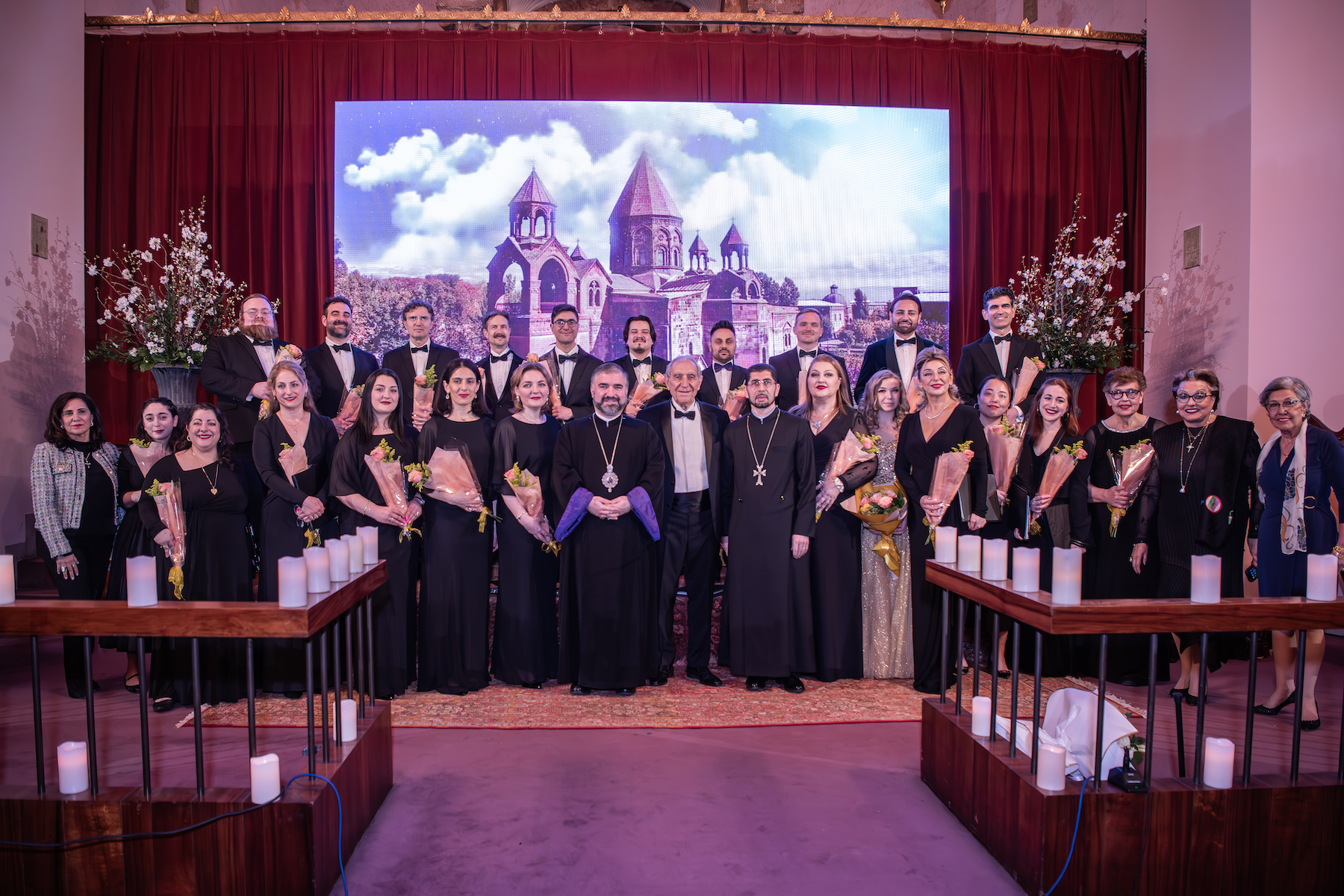
New York’s St. Vartan Armenian Cathedral played host to a stellar concert on March 15 titled “Hymns of the Heart,” honoring the 40th anniversary of the “Khorenian” setting the Armenian Divine Liturgy, and paying tribute to its distinguished composer, Maestro Khoren Mekanejian.
In 1980, His Holiness Vasken I, the late Catholicos of All Armenians, commissioned Khoren Mekanejian, at the time the choir director at Holy Etchmiadzin in Armenia, to compose an original Divine Liturgy. It took the musician three years to complete the task, but when he finally achieved what Catholicos Vasken envisioned, his liturgy became officially sanctioned for use in Armenian churches across the world, alongside only two other settings: those of Gomidas Vartabed and Makar Yekmalian.
A masterpiece of sound and devotion, which has been heard in sacred and concert settings all over the world, the Khorenian Badarak is the first version of the Armenian liturgy to have been specially commissioned and originally composed. In 2016, Maestro Mekanejian traveled to Armenia to lead the recording of the complete Khorenian Divine Liturgy.
“Hymns of the Heart” did full justice to the spiritual power of this sacred music, bringing it to life for an eager audience. As soloists, instrumentalists, and a full choir rendered concert versions of the hymns in the cathedral sanctuary, iconic images and video were projected onto a screen behind them.
Exquisite performances, dramatic lighting and production, and the solemn beauty of the cathedral all contributed to a sense of spiritual exaltation experienced by listeners.
The program placed excerpts from the Khorenian Badarak alongside other soulful works by the composer. Performing these was a roster of leading artists that included vocal soloists Vagharshak Ohanyan, Anoosh Barclay, Anahit Zakaryan, Hasmik Mekanejian, Alvard Mayilyan, Christopher Nazarian, and Hasmik Asatryan.
A grand professional choir was conducted by Maestro Mekanejian himself. Instrumentalists Ari Terjanian on the organ, and guest artist Alisa Saikova on the harp, offered sensitive interpretations of the maestro’s compositions.
In addition, at intervals the audience viewed video projections of Mekanejian’s life and work—including his interview describing his experience composing the Khorenian liturgy at the behest of Catholicos Vasken I.
Summoning the Emotion of a People
Diocesan Primate Bishop Mesrop Parsamyan presided over the evening, and delivered his own touching tribute to the composer in closing remarks. Bishop Mesrop recalled an episode from his own student days in Strasbourg, when he played the Khorenian “Der Voghormya” for a curious European clergyman. The listener, said the Primate, was moved to tears, and confessed to the young Fr. Mesrop that he had felt the sorrows of the Armenian people transmitted through the hymn.
“Later, I learned that Khoren had visited the Dzidzernagapert Genocide memorial,” Bishop Mesrop told the cathedral audience, “praying to the Lord and meditating on the meaning of our history of martyrdom, in preparation for composing his version of ‘Lord Have Mercy.’ He summoned all of that emotion and poured it into his music, so it could be felt, and remembered, by others for all time.”
The Primate closed by expressing his deep gratitude to Maestro Khoren, and congratulating the creative and diligent committee—Shoghag Hovanessian, Seta Kantardjian, Hasmik Mekanejian, Tamar Barsamian Degermenci, Lily Sarkissian, Sossy Setrakian, and Yn. Alla Terzyan Karamyan—who conceived and organized the tribute concert.
Click the following links to:
- VIEW an extensive gallery of concert photos by Harout Barsoumian.
- WATCH a video of Maestro’s recollections of the Khorenian Badarak.
* * *
The Music and the Composer
THE SACRED MUSIC OF THE ARMENIAN CHURCH is the oldest surviving music of the Armenian people. For centuries, the Divine Liturgy existed as a monophonic chant, or a single vocal melody. It was sung by a single voice or multiple voices, without accompanying harmony.
The Divine Liturgy as we know it today emerged in the late 19th century, when composers began to collect, arrange and harmonize this ancient music in European notation. The most well-known and widely performed setting is that of the Armenian composer Makar Yekmalian. He completed settings for a three-part male chorus and a four-part mixed chorus, which were officially sanctioned by Catholicos Mgrdich Khrimian in 1895.
At the turn of the 20th century, Yekmalian’s student, Gomidas, set out to recover what he thought was the lost purity of Armenian sound. He strove to arrange sacred music in a harmony he believed more closely mirrored the traditional Armenian sound of the Divine Liturgy. The Gomidasian Badarak, published in 1933, is the second most widespread setting used in the Armenian Church today.
In 1980, Armenian composer Khoren Mekanejian, then the choirmaster at Holy Etchmiadzin, was given the unprecedented task of composing an entirely new Divine Liturgy at the request of His Holiness Vasken I, the 130th Supreme Patriarch and Catholicos of All Armenians.
MAESTRO KHOREN MEKANEJIAN was born in 1937 in Aleppo, Syria. He entered the seminary of Holy Etchmiadzin and pursued studies there from 1956 to 1960 in the theology of the Armenian Church, as well as in philosophy, humanities and psychology. During his years at Holy Etchmiadzin, Khoren’s musical studies included music theory, polyphony and harmony under the private tutelage of Dr. Robert Atayan, the renowned master of Armenian sacred music and specialist in the music of Gomidas Vartabed.
Following the completion of his studies at Holy Etchmiadzin, Khoren matriculated at the Gomidas Conservatory in Yerevan, where he became a student of Tatoul Altounian. In 1965 he received a master’s degree in musical conducting and choral singing. Prior to receiving this degree, Khoren enjoyed the privilege of being second conductor for the State Academic Choir of Armenia, which was then directed by Hovannes Chekijian. He returned to the Gomidas Conservatory from 1975 to 1979, where he received another master’s degree in symphonic studies.
Maestro Khoren’s three‑year task of composing the choral and organ accompaniment to his original setting of the Armenian Divine Liturgy was crowned, after one year of trial use at the Mother Cathedral, with the official approval His Holiness Vasken I, the 130th Catholicos of All Armenians, in an encyclical dated October 20, 1984; the “Khorenian” liturgical setting is now in use in churches throughout the world. Maestro Khoren has also created other liturgical hymns and published articles on musical methodology. The central government in Moscow conferred the title of “professor of music par excellence” on Maestro Khoren in 1991.
Khoren Mekanejian had a decades-long tenure serving as director of Music Ministry at the Diocese of the Armenian Church of America in New York City, where he also directed the St. Vartan Armenian Cathedral Choir. He maintains the latter role to this day.
Throughout his distinguished career, Professor Mekanejian’s special mission has been to teach the correct interpretation of the chants and hymns of the holy badarak to choir members throughout the Diocese. Maestro Khoren was also very active as a composer. His compositions include a choral piece honoring the centennial of the Diocese (1998); a song about the holy city of Jerusalem and his Christmas Oratorio (2000), both dedicated to the 2,000th anniversary of Christ’s nativity; and a song honoring the 1700th anniversary of Armenia’s conversion to Christianity (2001).
In 1997, on the occasion of the Maestro’s sixtieth birthday, His Holiness Karekin I, the 131st Catholicos of All Armenians, awarded Maestro Khoren the prestigious “St. Sahag and St. Mesrob Medal” and pontifical encyclical, in recognition of his lifelong dedication and invaluable service to the Armenian Church. Subsequent decades have seen numerous awards bestowed, and milestones honored. In 2016, he accomplished the long-held dream of recording the Khorenian Badarak in its entirety, rehearsing and conducting a choir in Armenia for this purpose. The result was released on compact disc for posterity.