
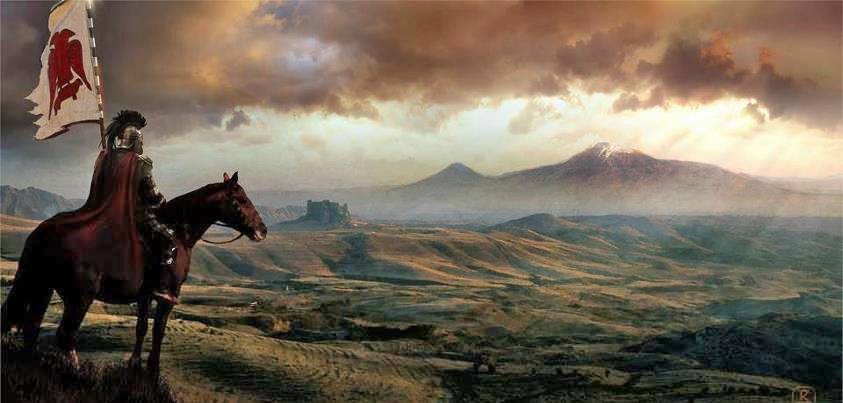
In honor of the Armenian Church’s “Feast of St. Vartan the Warrior and His Companions” (Feb. 12, 2026), read the oration Vartan delivered before his 66,000-man army, on the eve of the Battle of Avarayr in A.D 451—retold in English for a modern readership.
* * *
From their various positions around Armenia, the companies and divisions converged on the plain of Ardaz: a mighty force of sixty-six thousand men, including cavalry and infantry—nobles, freemen, and common folk. In their train came the saintly Catholicos Hovsep and the priest Ghevond, leading a contingent of fellow clergy and deacons. These hesitated not a bit at the prospect of going to war, for they saw that its great objective was not material, but spiritual—and in such a cause they would gladly lay down their lives alongside their valiant countrymen.
At last, the eve of battle arrived. As the sun was beginning to set, and the sky took on the fiery hues of twilight, the entire army mustered to receive instructions. Brave Vartan Mamigonian, sbarabed of Armenia, rose at the head of his noble commanders to address the troops. When he spoke, his tone was not that of a condescending lord, but of an elder brother, a comrade in arms, sharing his innermost thoughts with his peers. This is what he said:
“I have fought many battles in my time, and many of you have fought beside me. In some, our valor won the day; in others, we went down to defeat. I daresay the victories far outnumbered the losses. But every one of them was an earthly battle, fought at the command of a mortal king. Any coward who fled in the heat of combat knew scorn for the rest of his days. But we who kept up the advance—calmly, bravely—earned worldly fame, and material reward, for our courage. The scars and wounds that all of us bear on our bodies are the proof that the honors we received were real, and justified.
“Yet at this moment, as I look back, I see all those battles as profitless, the honors that came from them worthless—because in time they will crumble to dust, like everything else in this world.
“But the battle we are about to face is not of this kind. For our Commander today is not a mortal man, but the Lord of Life and Death. Whatever we were willing to give of ourselves to gain victory for a mortal king, how much more are we willing to sacrifice now, for the glory of our immortal King and Judge? Seen from the eyes of heaven, even the human blessing of old age is merely an obstacle to entering the presence of the Living God, and being separated from Him no more.
“I beg you now to hear these words, my brave friends, even though many of you are far greater than I in name and honor. But as the leader you chose of your own free will, I address my words to you all—to the great and humble alike. Have no fear before the heathen horde arrayed against us! Never turn your back in fright before the sword of a mere mortal! For if it is the Lord’s will to grant us victory, then we will smash the enemy’s power so that the cause of Truth may prevail. If, on the other hand, this battle is meant to crown our lives with a holy death, let us accept that, too, with joyful hearts—and without the slightest trace of cowardice spoiling our courage.
The Road to War
“I shall never forget the fateful trip to Persia that started our nation on the road to war. How some of our nobles—myself included—sought to mislead the lawless Prince of the East, to trick him like a child, by making a show of obedience to his impious orders. I pray the Lord bore witness to the secret truth of our actions: that we never broke faith with Him in our hearts, even as our hands laid sacrifices on a filthy pagan altar. All of you now know that we did it for the sake of our dear countrymen and fellow Christians, so that we might buy time to release them from their captivity, and together wage a rebellion against the Persian King on behalf of our God-given faith. In the end, alas, we were unable to help them. But our failure stamped a lesson on my heart: to never trade away the love of God to gain the love of men.
“Since then, by the Lord’s power, we have won some victories and acquired a name for courage. We dealt a mighty blow to the imperial armies; we decimated the Magi without mercy; the emperor’s wrath threatened to engulf us like a wave—but we beat it back. The king who had thundered above the clouds was brought low, abased and humbled before us. He who dreamed of crushing our holy church through words alone, now struggles to do so with bow, lance, and sword. He imagined that our Christian faith was like a suit of clothes, to be changed whenever the mood struck us. But now he has discovered that it is more like the hue of our flesh—which cannot change, and cannot be ex-changed. For our faith in Christ is anchored in rock—unshakeable! And nothing on heaven or earth—not rain or wind or rising floods—can move it. Here on earth we abide in flesh; but our true abode is in those heavenly structures built by no human hand, but by Christ alone.
“He is our true Commander, who will never forget the heroism you show this day. So stand firm with Him, my brave, noble Armenians! Through us, God will reveal His power to the world! And in this godly cause, if destroying the enemy brings glory to our names and to our church here on earth, then how much greater will be our heavenly reward if we die as a testimony to our Lord Jesus Christ? Even the deathless angels would envy us for our mortality, for they cannot give their lives as a gift to Christ, while we can.
“Yet it is not any kind of perfection in us that has merited this great opportunity, but rather the generosity of the Lord. As our Scriptures proclaim: ‘Where sin abounded, there God’s grace was even more abundant.’ How true those words are. For who has made their names more infamous than those of us who pretended to turn our backs on our ancestral faith? How many tears were shed by our families, by our church, when the news arrived of our submission to the pagan king? How many threats did we receive from our own people? Even distant nations who had admired us for our fidelity to Christ, and who knew nothing of our true intentions, heaped curses upon us for our apparent lack of faith. And believe me, not only men on earth, but even the angels in heaven turned their faces from us in shame and embarrassment.
“Well, the day has now arrived for us to throw off every suspicion, and redeem our former disgrace. At the time, we were sick with grief, in body and soul. But today we are overflowing with joy, yet quietly composed, for we recognize the Lord before us as our Leader. We are not led by a mere man, but by the Commander of all martyrs. In His mighty hands I feel no fear. Fear is the companion of Doubt. But we vanquished Doubt long ago; so let Fear too run away, and leave our hearts and minds free to act!”
A General Among His Men
With such words, the warlord of Armenia addressed his entire host of soldiers. Afterwards, as the troops broke up into small groups, Vartan walked throughout the camp, among the campfires, stopping here and there to speak with his men in private, to encourage them and buck up their spirits. If in the course of such talks, it turned out that a soldier lacked anything—clothes, armaments, a horse—Vartan would make sure he was provisioned, often out of his own resources.
To cheer them while they ate, he told them stories of the valiant men of old—especially the exemplary figures of the Bible, for Vartan had been tutored in the Holy Scriptures since his youngest days. By firelight, he read to them from the Book of Maccabees: how this ancient Hebrew clan had led a struggle against the mighty pagan king Antiochus Epiphanes, to preserve and defend their God-fearing religion. Though the battle ended in their deaths, he stressed, the memory of the Maccabees had lived on, down through the ages, and was still honored on earth as in heaven.
From the same Scriptural source, Vartan read the story of the old Hebrew priest Mattathias, father of Judah Maccabee, who stood firmly in his faith even when his own kinsmen defected to the pagan enemy. Yet Mattathias did not slacken in his fidelity to God, but became more adamant, gathering around him like-minded Hebrews, and inspiring the war of liberation chronicled in the Bible.
Deep into the night, Vartan related these ancient tales, and the similarity with their present-day cause was not lost on even the simplest Armenian conscript. Finally, the camp was quiet, the troops asleep, and the sentries stood watch around the perimeter.
* * *
By Christopher H. Zakian, from the newly-published book, Faithful Saints of Christ, retelling Yeghishe’s epic chronicle of the Vartanantz war.
Pictured above: A fine modern illustration of Vartan scanning the plain of Avarayr, from R. Kupelian’s “East of Byzantium” saga.