
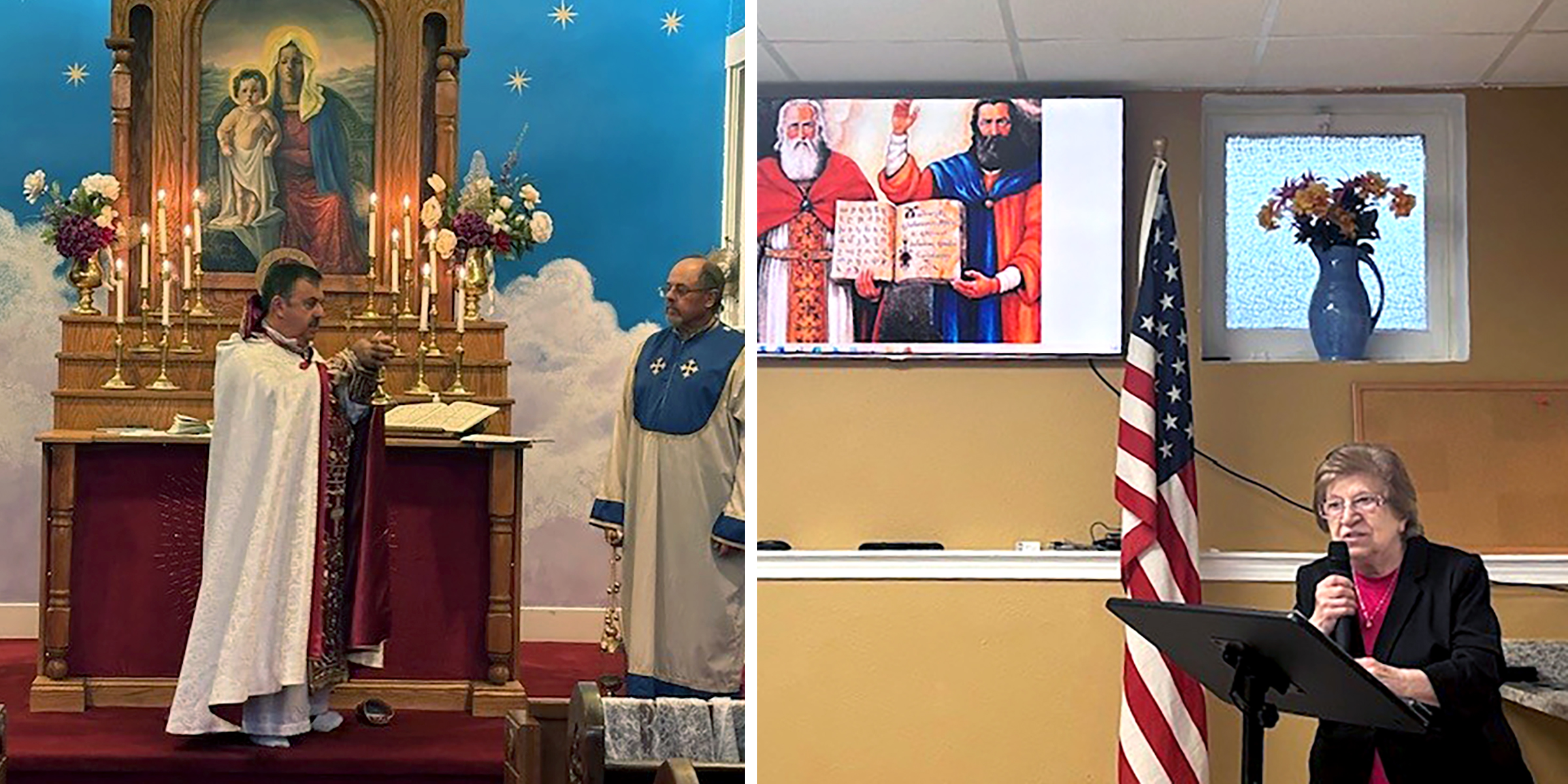
The Diocese’s mission parish in Kansas City, MO–St. Garabed Armenian Church–welcomed Armenian Cultural Month with a special observance of the Feast of the Discovery of the Holy Cross, and a presentation on milestones of the Armenian cultural heritage.
On Sunday, October 26, visiting pastor Fr. Nareg Keutelian celebrated the Divine Liturgy. In a sermon on the history and meaning of the Discovery of the Holy Cross, Fr. Nareg recounted the 4th-century origins of the Feast in the pilgrimage of St. Helena, mother of Emperor Constantine, to the Holy Land, in a quest to uncover the True Cross upon which Jesus Christ was crucified. He emphasized that the feast remains a timeless reminder of the redemptive power of faith, the enduring truth of the Gospel, and the central role of the cross in Armenian Christian identity.
Armenians in the Holy Land
Following the badarak, parishioners gathered in the newly renovated Bedross Hall, which was decorated to reflect the spirit of the Armenian heritage. The Armenian Cultural Month gathering drew enthusiastic participation from the community and highlighted Armenian history, language, and faith.
The keynote presentation was delivered by Rose Youssefi, a former resident of Jerusalem, who began by explaining the origins and significance of Armenian Cultural Month and why it is celebrated in October.
She noted that the observance coincides with the Feast of the Holy Translators, held on the second Saturday of October, honoring St. Mesrob Mashdots and St. Sahag Bartev, the creators of the Armenian alphabet and translators of the Holy Bible. She also paid tribute to other sainted scholars, including Yeghishe, Movses of Khoren, David the Invincible, and Nersess Shnorhali, whose writings and translations enriched Armenian Christian thought across centuries.
Her presentation titled “The Armenian Presence in the Holy Land” explored the deep-rooted Armenian legacy in Jerusalem and its surrounding regions. She emphasized the Armenians’ role as equal custodians of holy sites and their longstanding contributions to the Christian community.
Highlighting the trilingual sign at the entrance of the Sts. James Armenian Monastery—written in Armenian, Arabic, and French—Mrs. Yousefi noted that the name “Couvent Arménien St. Jacques” refers to two historic figures from the gospels: James the Brother of the Lord, and James the Son of Zebedee. Mrs. Yousefi concluded by encouraging attendees to visit Jerusalem to experience the Armenian presence and heritage at first hand.