
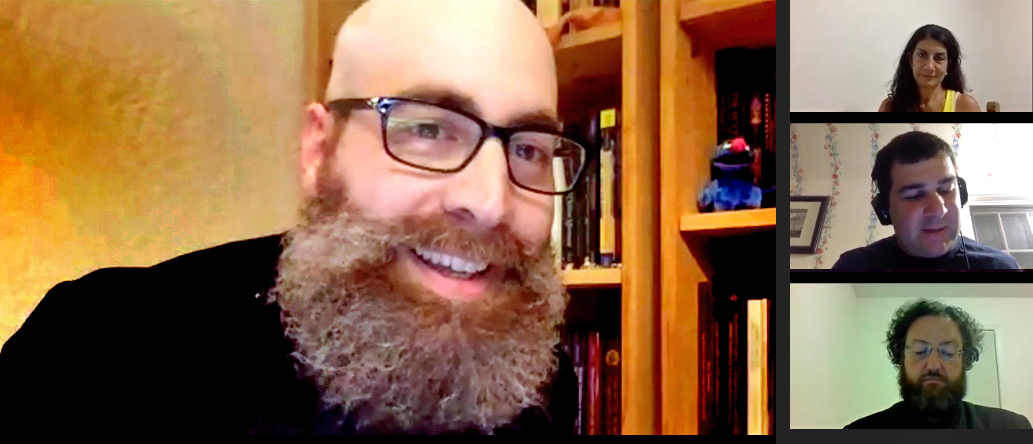
An illuminating presentation in the Eastern Diocese’s online educational series explored the way Christian ideas of healing compare to the healing traditions of other religions.
Deacon Eric Vozzy led the discussion as part of the “Live Sessions” series of broadcasts, presented by the Eastern Diocese of the Armenian Church of America as a feature of its new educational initiative, Vemkar. The title of his October 7 talk was “Comparative Religions on Healing,” and built on the theme of Vemkar’s inaugural module, “Christ as Healer.”
Dn. Eric looked at the approaches to healing in Hinduism, Buddhism, Islam (including Sufism), and Judaism, contrasting these with the approach in Christianity.
All five of these world religions share a belief in the brokenness of humanity, its need for healing, and the obligation to bring healing to others, Dn. Eric explained. He considered a series of questions to reveal what each religion believes about healing. For example, does the given religion look at healing holistically—as a function of body, mind, and soul? How does healing fit in with the larger objectives of each religion? How does it understand suffering? Is healing temporal, or does it have an eternal or salvific significance? And what kinds of healing customs arise from the respective religions?
Examining each religion’s approach in turn, Dn. Eric sketched pertinent characteristics of their healing traditions. In Hinduism, for example, “Health reflects a proper balance and a smooth functioning of the body,” he said, “and medical practice seeks to promote this balance by means of nutrition and a minimum level of invasive intervention.”
He noted that the “Four Noble Truths” and the “Eightfold Path” direct the Buddist away from suffering, and towards enlightenment. He mentioned that among the 99 names of God in Islam—each of which conveys a different attribute of God—one of the names is “The One Who Cures.” In Judaism, spiritual healing is often effected by contemplation of the Book of Psalms—a practice also employed in Armenian Christian spirituality.
Christianity, Healing, & Forgiveness
When Dn. Eric spoke on healing as understood in Christianity, he approached it through the Gospel account of Jesus healing the paralytic man, who was lowered through the roof by four friends. Jesus forgives the paralytic’s sin and the latter is healed—which suggests a connection in Christianity between forgiveness and healing.
Indeed, as Dn. Eric described it, forgiveness is a kind of divine healing that unbinds us from the condition of sin, and sets human beings free. In the Christian understanding, forgiveness unites and makes whole, brings us back into communion with God and with one another.
Under this understanding, the Christian sacraments and rituals of the church, Dn. Eric said, can be seen as opportunities for healing. The badarak, Kiss of Peace, Water Blessing, Penance, Home Blessing, Marriage, and Funeral sacraments, among others, are occasions to experience God’s healing and salvation.
Participants in the video conference had an opportunity to pose questions, which allowed Dn. Eric Vozzy to build on some of the insights in his talk.
You can find out about upcoming events in the Live Sessions series on the Vemkar.us website. There you can view archived Live Session recordings, find the schedule of Live Sessions, and access links to register.
Click here to learn more. Vemkar is the major educational component of Building Up the Body of Christ, Diocesan Primate Bishop Daniel Findikyan’s vision for the Eastern Diocese and its parishes.