
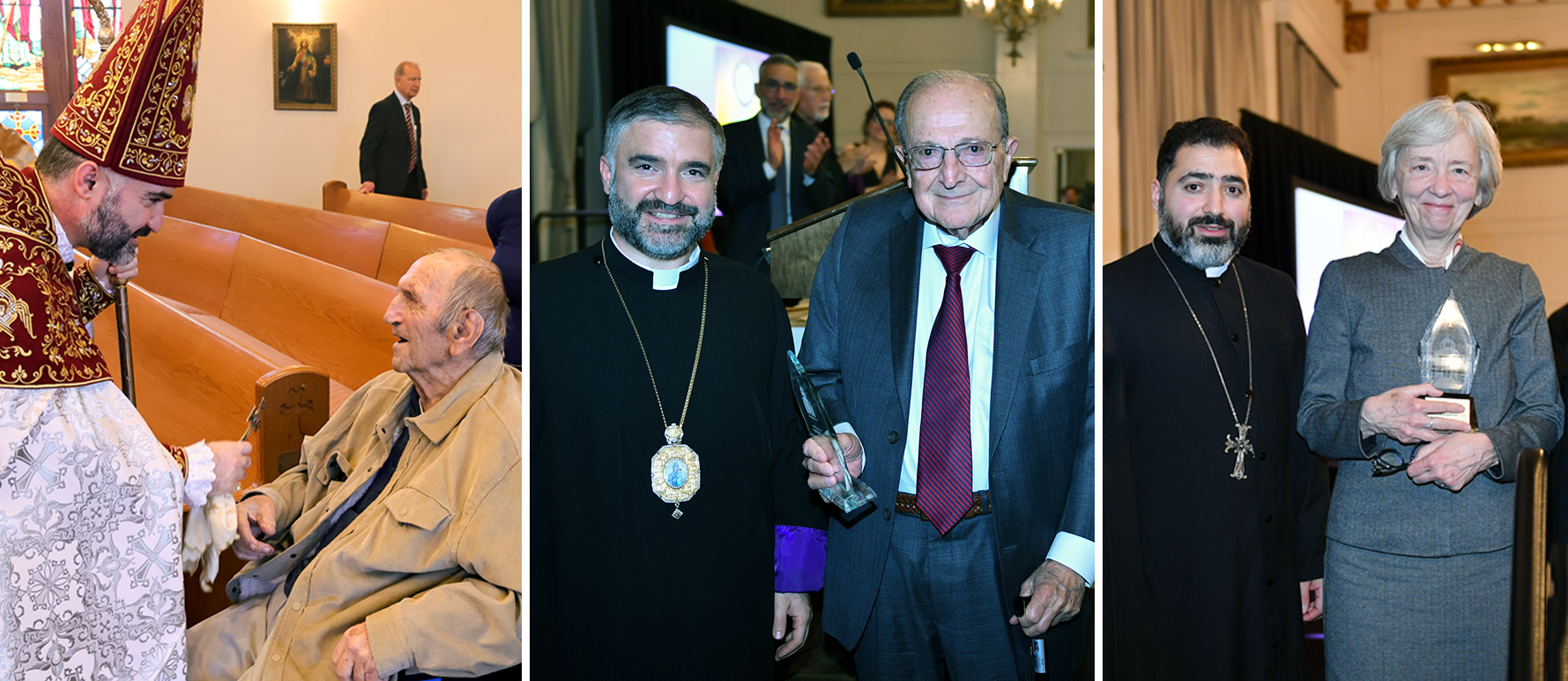
The crown jewel of a memorable week in Milwaukee, WI, was the 124th Diocesan Assembly Gala Banquet, held in the grand Imperial Ballroom of the Pfister Hotel on Friday, May 1.
The host parish, Milwaukee’s St. John Church, ensured that the banquet was an elegant stage on which to honor church leaders for their contributions to the life of the Eastern Diocese of the Armenian Church of America.
Primate Bishop Mesrop Parsamyan presided over the evening. Diocesan Legate Archbishop Vicken Aykazian delivered the invocation. Words of welcome were given by parish council chair Lyle Dadian, and Diocesan Assembly chair Herman Purutyan offered a toast. Host parish Assembly Committee chair Harold Aghjian delivered warm remarks to the assembled guests and dignitaries.
Remarks by the host parish pastor, Fr. Guregh Hambardzumyan, connected listeners to the parish’s deep Milwaukee roots. He spoke of the construction of the community’s first sanctuary in the 1940s, and its consecration by Archbishop Karekin Hovsepian—the great churchman who would later become Catholicos of the Great House of Cilicia. This historical link has served the parish as a powerful reminder of its strength and continuity.
The evening’s celebratory atmosphere was enhanced by a stunning musical program, featuring a melodic performance on the traditional Armenian instrument, the Qanun, played by sisters Lilia and Alexandria Yaralian, accompanied by Dimitri Glarus on the piano.
The highlight of the evening was the presentation of Diocesan awards to three distinguished honorees: “Armenian Church Members of the Year” Ara Cherchian and John Kaishian, and “Friend of the Armenians” Dr. Robin Darling Young.
Ara Cherchian was honored for his immense generosity and dedication to the St. Vartan Cathedral Renovation Project and numerous vital projects in Armenia. In his gracious remarks, Mr. Cherchian reflected on his upbringing in Iran, and his arrival in America to pursue education at Rensselaer Polytechnic Institute and the University of Chicago—which eventually led Ara and his wife Valerie to Milwaukee, beginning their deep and abiding devotion to the city’s Armenian community. He extolled the church for preserving Armenian identity and the virtues that have allowed Armenians to prosper in the U.S.
John Kaishian was celebrated for his visionary gift providing his property for over 30 years to host Hye Camp, the foundation upon which generations of Armenian youth in the Midwest have built their identity. John Kaishian’s son, Fr. Sahak Kaishian, accepted the award on behalf of both his parents, recalling the foundational role several generations of his family have played in the life of the Milwaukee Armenian Church community, and thanking the Diocese for recognizing his father with the award.
A Beacon of Faith
The distinguished scholar from Washington, DC, Dr. Robin Darling Young, was honored as this year’s “Friend of the Armenians” for her profound contributions to the study of Classical Armenian and Armenian theology. In her remarks, Dr. Young recalled the moment in her life when she first encountered the writings of Movses Khorenatsi, and was introduced “to a civilization as compelling as it was fascinating.” She thanked the Diocese and the entire Armenian community for welcoming her and embracing her scholarship, and looked forward to continuing a lifetime of study, bringing the intellectual and spiritual treasures of the Armenian heritage to the global audience.
As the banquet concluded, Diocesan Primate Bishop Mesrop Parsamyan shared a poignant closing reflection. Inspired by a visit to Milwaukee’s North Point Lighthouse, Bishop Mesrop noted its unique status as a beacon situated on land rather than at the sea’s edge. He drew a powerful connection to the Assembly’s theme, “Renewed in Hope,” stating that the church serves as an “inland lighthouse” a steadfast guide that leads the faithful through life’s uncertainties while remaining anchored in the firm ground of tradition.
The Primate went on to praise Fr. Guregh and Yn. Silva, the host parish committee leaders and volunteers, and all the parishioners for extending their warmth and hospitality to the visitors from across the Diocese.
The spiritual energy of the event spilled out into the city itself, as Milwaukee’s iconic Hoan Bridge was illuminated in the Red, Blue, and Orange colors of the Armenian flag throughout the evening hours of May 1, as a tribute saints, martyrs, and survivors of the Armenian Genocide. As the bridge glowed against the city skyline, it stood as a symbol of a community that remains a radiant and unshakeable source of light in the world.
St. John Church’s Diocesan Assembly executive committee, under the presidency of pastor Fr. Guregh Hambardzumyan, included Harry Aghjian (Chair), Maritza Armagan (Vice Chair), and Gary Seabrook (Treasurer). Subcommittees were led by Mary Keutelian (Website & Social Media; Commemorative Booklet), Yn. Diana Keutelian (Registration), Yn. Silva Hakopyan (Yeretzgins’ Breakfast), Laurie Dadian (Welcome Desk), Nancy Seabrook (Gala Banquet), Ramelann Kalagian (Badarak Luncheon), David Luhrssen (Publicity), Donald Rask (Photography), and Larry Dadian (Transportation).
Organizing Committee Members included Casey Aghjian, Alina Atayan, Joanie Baylerian, Michelle Baylerian, Marissa Baylerian, Lisa Boyadjian, Bryan Boyadjian, Lyle Dadian, Nicole Dadian, Sandy Densmore, Knarik Fasulyan, Kristina Faryants, Larisa Feriyans, Jan Gred-Hammer, Kerrie Kashian, Russell Kashian, Sue Kashian, Noubar Kazazian, Rev. Fr. Nareg Keutelian, DeAnn Kokott, Jan Kopatich, Inna Petrosyan, Donald W. Rask, Anastasia Vasilyeva, EvaSophia Vasilyeva, Angelina Weitzer, and Arpik Weitzer.
Click the links to view photos of the 124th Diocesan Assembly Banquet, and to watch a video digest of the assembly and banquet proceedings.
Meet the 2026 Diocesan Honorees
Every year the Eastern Diocese bestows its “Friend of the Armenians” and “Armenian Church Member of the Year” awards to express gratitude to people who have profoundly benefitted the church; to deepen existing relationships with important figures in the community; and to strengthen the honorees in their continuing efforts.
This year’s distinguished “Friend of the Armenians” award-winner, Robin Darling Young, Ph.D., is Ordinary Professor, Emerita, of the History of Christianity at the Catholic University of America in Washington, D.C. Her specialty is in the history of eastern Christianity in the ancient world, with a particular focus upon the interactions of the three main cultures of that world—Armenian, Greek and Syriac. She is particularly interested in the history of the ascetic movement—and in particular, in the thought and writings of Evagrius of Pontus, a saint celebrated in the Armenian calendar on February 11.
Professor Young is a native of Hampton, VA. She completed her undergraduate studies at Mary Washington College in 1972 and then worked at the Folger Shakespeare Library and as a journalist at a local weekly newspaper in Fairfax, VA. In 1974 she began graduate studies at the University of Chicago, where she earned her M.A. and Ph.D. in the History of Christianity under the direction of Prof. Bernard M. McGinn with a dissertation “The Patriarchate of Severus of Antioch, 512-518.”
Having begun her teaching career at Wesley Theological Seminary in Washington, D.C., Professor Young studied in 1984-1985 at the Oriental Institute of the University of Oxford, where she was a member of Wolfson College. She began to study Classical Armenian there, under the instruction of Tübingen professor Gabriele Winkler, the noted historian of the liturgy. Upon returning to Washington, Professor Young began further studies in the Armenian language with Robert W. Thomson, Armenian Studies Professor at Harvard and Director of the Dumbarton Oaks Library. After her appointment to the faculty of The Catholic University of America, she completed her first Armenian publication, a translation of the 5th-century bishop Eznik of Kolb’s On God/ Against the Sects, with Monica Blanchard (Peters Press, 1998).
In 1997, Professor Young was visiting professor of Armenian Studies in the Oriental Institute at the University of Chicago; she taught for ten years at the University of Notre Dame (2003-2013), one year at the University of Virginia, after which she returned to Catholic University. As a scholar of the works of Evagrius of Pontus, she led a team that translated his Gnostic Trilogy (Oxford, 2024) but had already published, with her doctoral student Fr. Hovsep Karapetyan, Evagrius Ponticus, Letters: Armenian Translation (Peeters, 2002). In the next several years she plans to publish an English translation of the Synac version of his letters, along with a monograph on Evagrius’ life and thought.
Professor Young has been a longtime member of the Oriental Orthodox-Roman Catholic Dialogue and, as an admirer of Armenian culture, has tried to contribute to the study of Armenian language and history at The Catholic University, where the language has been taught since its founding in 1887. With Prof. Stefanos Alexopoulos, she remains co-director of the Institute for the Study of Eastern Christianity that hosts the Shahinian lecture series and other Armenian scholars who have brought the knowledge of Armenian culture to students and faculty at the University.
Prof. Young and her husband, Attorney Malcolm C. Young, are the parents of five children and six grandchildren.
A Life of Leadership, Enterprise, & Service: Ara Cherchian
One of two “Armenian Church Members of the Year” for 2026, Ara Cherchian was born in Tehran, Iran, into a close-knit Armenian family. He was the son of Haroutun Tchertchian and Sirarpi Kehyayan, and grew up alongside his brothers, Armen and Onig Tchertchian. From an early age, Ara was shaped by strong family values, a commitment to education, and a deep sense of cultural identity that would guide him throughout his life.
He later married Valerie A. Cherchian, with whom he built a loving family. Together they raised two sons, Alex and Peter Cherchian, and were blessed with five grandchildren: Zachary, Brittany, Samuel, Victor, and Ivan. Family remained at the center of Ara’s life, grounding his many professional and philanthropic pursuits.
Ara pursued higher education in the United States, earning a degree in Mechanical Engineering from Rensselaer Polytechnic Institute in 1960. Demonstrating both technical aptitude and a keen interest in business, he continued his studies and obtained a BA in Accounting and Finance from the University of Chicago in 1969. This combination of engineering and financial expertise laid the foundation for a distinguished career in industry and leadership.
He began his professional journey as a Plant Manager at Continental Can, where he worked from 1960 to 1969. His capabilities quickly became evident, leading him to Schlitz Brewing Company, where he served as Vice President and General Manager of the Container Division from 1969 to 1983. Ara continued to expand his leadership experience as Vice President of Operations and Strategic Planning at General Tire and Rubber (1983-1986), followed by Vice President of Strategic Planning at Aqua Chem (1986-1988).
In 1988, Ara took on an entrepreneurial path as President and Owner of Northland Stainless Inc., a role he held until 2007. During this period, he also served as Managing Partner of Northern Wire LIC from 1998 to 2012, further demonstrating his business acumen and strategic vision. Since 1998, he has continued his work as President of Cherchian Investments, overseeing a range of ventures and investments.
Beyond his professional achievements, Ara has been deeply committed to philanthropy, particularly in Armenia. Through his involvement with the Paros Foundation, he has supported numerous impactful initiatives, including the Vanadzor Education Center, the Syunik Beekeeping Project, home construction efforts, the Noyemberyan Art and Community Building, the Akunk Village Medical Center, the Berd Community Center, and the Achajur Kindergarten. These projects reflect his enduring dedication to community development, education, and humanitarian support.
Ara’s charitable contributions extend widely across educational, cultural, medical, and community organizations. He has supported institutions such as the American University of Armenia, Armenia Fund USA, the Armenian General Benevolent Union, and the Armenian Assembly of America. His generosity has also reached organizations like St. Jude Children’s Research Hospital, the Milwaukee Symphony Orchestra, Hillsdale College, the Milwaukee Public Museum, and numerous Armenian churches and community foundations. Through these efforts, Ara has made a lasting impact on countless lives both in the United States and abroad.
In his personal life, Ara has cultivated a range of interests that reflect both creativity and appreciation for the outdoors. He enjoys lapidary work and mineral collecting, boating and fishing on Lake Michigan, golfing, traveling, and participating in church life. He is also a supporter of the arts, particularly the Milwaukee Symphony Orchestra.
Ara Cherchian’s life is a testament to perseverance, leadership, and generosity. From his caly beginnings in Tehran to his achievements in business and philanthropy, he has remained dedicated to building, supporting, and enriching the communities around him. His legacy is defined not only by professional success but by a profound commitment to family, culture, and service.
From Generosity to Legacy: The Kaishians’ Hye Camp Story
The Eastern Diocese second honoree as “Armenian Church Member of the Year” is John Kaishian. John and his wife Lynn stand as foundational figures in the history of Hye Camp and the broader Armenian church community in the Midwest. Their legacy is deeply intertwined with the perseverance, growth, and success of a vision that began decades before it could fully take root.
In the late 1950s and early 1960s, several earnest attempts were made by individuals and the Midwest Regional Council of Armenian Churches to establish an Armenian camp in the Midwest. Despite strong intentions, these early efforts ultimately faltered due to a lack of funding and consistent leadership. The dream of a regional camp remained alive but unrealized.
In 1963, John and Lynn Kaishian stepped forward with a generous offer: they made their Personal property in Pleasant Lake, Wl, available as a potential site for what would become Hye Camp. Although the organizing committee explored other locations over the following two years, those efforts again fell short for the same reasons—limited resources and leadership challenges.
Recognizing the importance of the mission, the Kaishians renewed their offer. This time, their contribution became the cornerstone of success. For the next 30 years, the diocesan Hye Camp was held on their property. As the guiding forces of their extended family, John and Lynn created an environment of collective service. Their entire family played an active role in supporting the camp—preparing and serving meals, organizing sports and activities, and meeting the countless needs that arise in running a successful camp.
What made their contribution even more extraordinary was the spirit in which it was given. For three decades, the Kaishians provided not only the land but also the food entirely free of charge. This remarkable generosity allowed the camp to maintain minimal tuition costs, ensuring that children from families of modest means could participate and benefit from the experience.
The impact of Hye Camp has been profound. Over the years, it has nurtured future clergymen of the Armenian Church, cultivated leaders within both the church and the camp itself, and fostered lifelong connections among campers. Many Armenian campers formed lasting bonds that led to marriage—an especially meaningful outcome within the Armenian community-and today, their children continue the tradition, attending and even leading the camp.
It is widely acknowledged that without the Kaishians’ “princely” donation—a term of deep respect within Armenian culture-Hye Camp would not exist today. In 2013, the camp celebrated its 50th anniversary, standing as the oldest continuously operating Armenian camp in the Americas, a testament to the enduring impact of their generosity.
The Kaishians’ contributions extended well beyond the camp. In 1968, they made another significant donation toward the construction of the first phase of their church in Greenfield. This initial structure, a cultural hall, served as the site of the Divine Liturgy until the sanctuary was completed in 1986. In recognition of their generosity, the hall was named in their honor. During the sanctuary’s construction, they again contributed substantially, and were subsequently recognized among the church’s Godfathers.
Both John and Lynn were also deeply involved in leadership within the community. John was an active member of the Knights of Vartan and served as a former commander of the Cilicia Lodge. Lynn was a dedicated member of the Hripsime Otyag, where she held numerous leadership roles, including Otyag Dirouhi, secretary, and other positions of service. Together, they served on the parish council and were members of the church’s building committee. Lynn further contributed through the Women’s Guild, where she served as chairperson, secretary, and treasurer.
Through their unwavering commitment, generosity, and leadership, John and Lynn Kaishian helped shape not only Hye Camp but also the spiritual and cultural life of their community. Their legacy continues to live on in the generations they inspired and the institutions they helped build.
# # #