
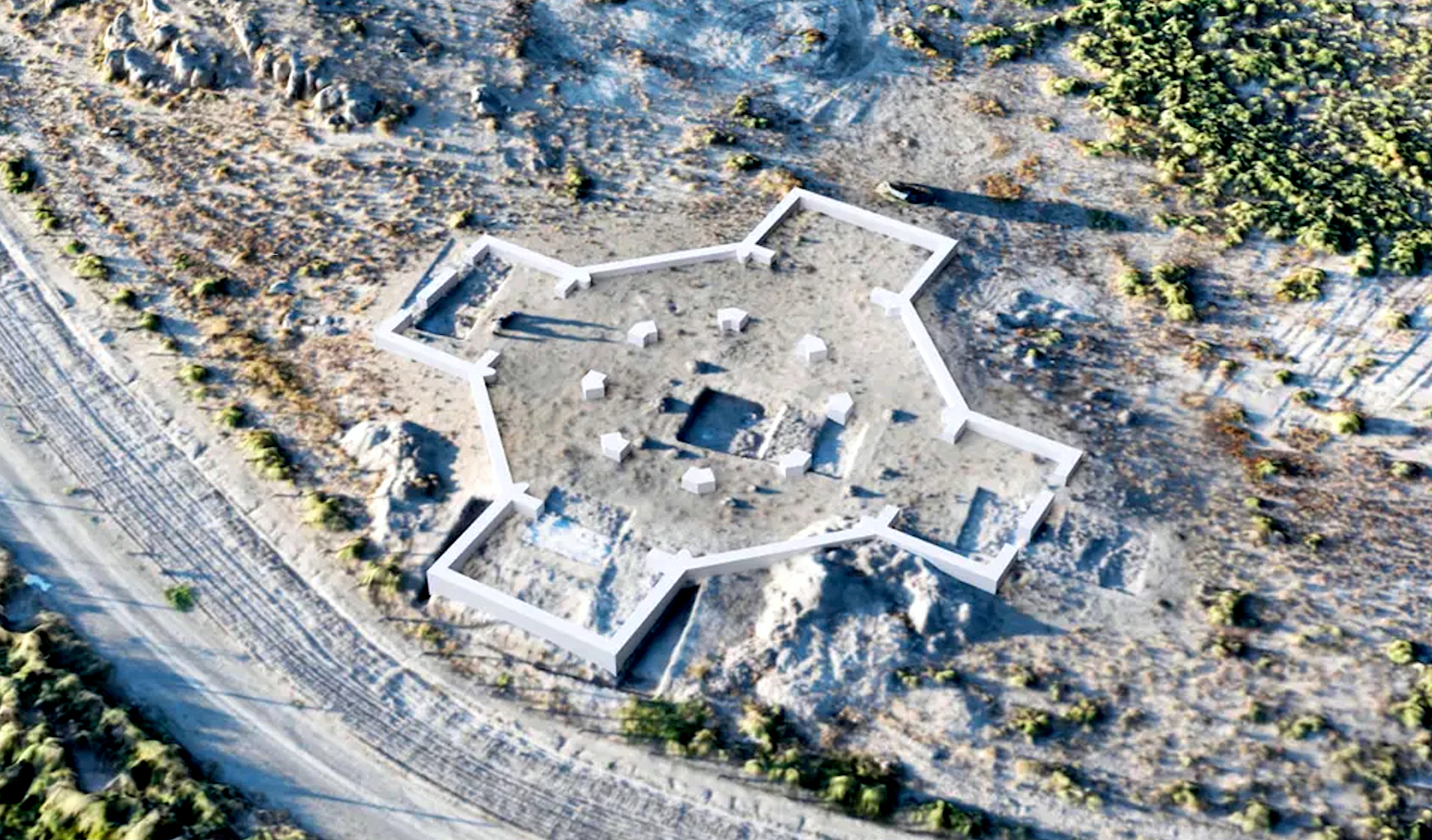
The online version of Smithsonian Magazine (the official journal of Washington, DC’s Smithsonian Institution) recently featured news of an archaeological dig that has uncovered one of the oldest Christian churches in the world.
The exciting discovery was made in Armenia, in the history-rich region of Artashat—known anciently as Artaxata, the capital of pagan Armenia. Khor Virab, the monastic complex associated with the imprisonment of St. Gregory the Illuminator, lies a few miles to the south of the site, with Holy Etchmiadzin about 20 miles to the north.
The church is described as “an octagon with cross-shaped extensions,” which appears to combine elements of the eight-sided structures seen in Mediterranean churches, with the cruciform shape pioneered by Armenia’s early church architects. The image above is a digitally-enhanced reconstruction showing the original shape of the church’s now-eroded foundation walls.
Radiocarbon analysis of wooden elements at the site date the church to A.D. 350, placing it within a generation or two of Armenia’s conversion to Christianity in 301. That dating also designates the site as one of the oldest Christian churches on record.
Interestingly, buildings specially designated as Christian worship centers were not known in the Apostolic Age (when Christianity first penetrated Armenia), nor in the periods of Christian persecution that followed. The world’s oldest structure purposely built as a Christian church is in Aqaba, Jordan, erected between 293 and 303; the Church of the Holy Sepulchre in Jerusalem, and the Church of the Nativity in Bethlehem, date to the late 320s.
Symbolic Architecture
The ongoing excavation in Artashat is being undertaken by a joint German-Armenian team of researchers from the University of Münster and the Armenian National Academy of Sciences. They first discovered the church’s remains in 2023, and returned to excavate in 2024, with further study to come.
The site’s octagonal footprint measures nearly 100 feet across, laid with a “simple mortar floor and terracotta tiles,” according to a statement by the archaeologists. The scientists added that while the eight-sided church shape has been unknown in Armenia until now, the octagon has a long history as Christian symbol, evoking the number of days that passed between Jesus’ entry into Jerusalem (on Palm Sunday) and His resurrection (on Easter).
Click the following link to read more on Smithsonian Magazine’s website.
And in this season of Christ’s birth, take a moment to reflect on the depth of loving conviction that inspired our ancient Armenian ancestors to embrace and worship the Lord Jesus Christ.