
Professor Mark Movsesian, co-director of the Center for Law and Religion at St. John’s University Law School, was the guest speaker during the celebration of St. Vartan Day on Thursday, February 16, 2023, at New York’s St. Vartan Armenian Cathedral.
Read the text of his stirring remarks for the occasion below.
* * *
St. Vartan and the Armenian Christian Identity, Then and Now
Most of us here have heard the story of St. Vartan and his companions many times: about how, in the Fifth Century, when the Persian Empire sought to eradicate Christianity in Armenia and forcibly convert Armenians to the Zoroastrian religion, the nakharar, Vartan Mamigonian, led a rebellion against it; how the outnumbered Vartan and his companions were defeated and killed at the Battle of Avarayr in 451 (after being deserted by Vasak and other nobles who sought an accommodation with the Persians); how the Persians took captives, including Catholicos Hovsep and the priest, Ghevond, and eventually murdered them; but how, a generation later, Vartan’s nephew, Vahan, continued the rebellion and how, as a result of his military skill and shrewdness as a leader, as well as other political and military factors, the Persians eventually gave up the campaign and granted Armenians freedom to practice Christianity in the Treaty of Nvarsak in the year 484.
The story of Vartan and his companions is a stirring one and, for us Armenian Christians, a miracle: the working out of a Providential design that included abandonment, failure, betrayal, and sacrifice—but also courage and perseverance and ultimate victory. It is also a story that resonates in our own time. Once again, today, Armenians face grave danger from an external enemy that seeks to eliminate a specifically Armenian Christian identity in our historic home, and once again the situation looks dire. As we gather this evening, the Azeri government is blockading 120,000 Armenian Christians in Artsakh in an attempt to force them to leave the region—an obvious ethnic cleansing campaign. In his roughly contemporaneous account of Vartan and his companions, written at the end of the Fifth Century, Ghazar Parpetsi tells his readers that he will describe “events, times and occurrences in the land of Armenia over the turbulent centuries, periods of occasional peace and times of intense and endless confusion.” Today Armenians are again living through a “time of intense confusion,” about what is happening in our homeland and how we can best respond, both in our homeland and in a diaspora that extends far beyond what Parpetsi could ever have imagined.
There are many ways to understand the story of Vartan and his companions: in terms of imperial politics, military strategy, or even economics. Parpetsi writes of how rich the land of Armenia was, how tempting a prize for the Persian king. But I would like to reflect this evening on two aspects of the story. The first is what the story reveals about the link between Christianity and Armenian identity. For us, and for the people around us, Christianity is the essential element in our culture—the thing that distinguishes us from our neighbors and that, periodically, makes them perceive our collective existence as a challenge. Second, I would like to reflect on what the story reveals about the need for perseverance and shrewdness in the face of oppression and about the ultimate victory of God’s plan.
Parpetsi and Yeghishe, the other contemporary historian of events, make clear that Vartan rebelled because the Persian king wanted him to renounce Christianity and embrace the Zoroastrian religion. Vartan was the grandson of the great Catholicos of the Armenian Church, Sahak, and was regarded by his contemporaries, Parpetsi says, as “a learned and informed man—extremely well acquainted with” the Scriptures and other Christian writings. Vartan’s knowledge of the Christian faith allowed him to debate quite skillfully with the Persian magi—in a way that is quite astonishing, today, in fact, when we don’t expect military and political leaders to know much about religion. During one debate, Parpetsi recounts, Vartan told the Persian king:
“It is impossible for me to alter the faith I have learned from God, from my childhood, out of the fear of man. For I would consider myself pitiful if I were to apostasize from the just doctrine which is firm in my mind (and which I regard as correct), even though received from a man; let alone to betray the faith which I received and studied from the mouth of God, because of the fear of man and to seek futile glory.”
This was Vartan’s conviction. But it is also clear from Parpetsi and Yeghishe that Vartan’s stand was not perceived, by himself or by anyone else, as a solitary one. Unlike most other warrior saints—Joan of Arc is a notable exception—Vartan’s story is inescapably connected to a particular national identity. We don’t think of St. George or St. Sarkis, whose feast we celebrated earlier this month, as Romans, particularly. We remember them as individual soldiers who refused to renounce Christ; their nationality is incidental. But just as Joan of Arc represents a specifically French Christian identity, not Christianity-in-General, so Vartan represents a specifically Armenian Christian identity. Vartan’s nationality is central to his story.
That’s how Armenians like Parpetsi and Yeghishe saw it—and it’s also how the Persians saw it. Persian officials like the Prime Minister, Mihr Narseh, who figures prominently in the story, were genuinely devoted to the Zoroastrian religion and wanted to evangelize for it. They wanted to save souls. But their aims were not only spiritual. The Persians wanted to assimilate Armenians to Persian culture generally—to make Armenians, Persians. If the Armenians could be made to accept our customs, including our religion, and intermarry with us, one minister advised the king, they would no longer be a threat to Persian unity. (The fact that Armenians followed a religion associated with the Byzantine Empire, Persia’s great rival, made the Persian bureaucracy suspect Armenians even more). And the penalty for refusing to accept Zorastrianism would not be limited to individual dissenters but imposed collectively. “Should you Armenians” resist conversion, Parpetsi records the Persian king warning Vartan and other assembled nobles, “as, indeed, to the present you have held an erroneous faith—should you stubbornly persist” in following Christianity, “I shall wipe you out, with your women, children, and nation.”
Now, Persian culture is ancient and venerable and has much to recommend it. And Persian and Armenian culture have strong affinities. The royal dynasty that made Armenia the first state to adopt Christianity as a state religion in 301 A.D. was an offshoot of the Iranian royal family. But Parpetsi and Yeghishe make very clear that that the thing that distinguished Armenian culture from Persian culture was the one thing Armenians were unwilling to give up: Christianity. “No one can remove us from this belief,” Yeghishe has the assembled Armenian clergy tell Mihr Narseh, “neither angels nor men, neither sword nor fire, nor water, nor any cruel beatings.” And that one thing, Christianity, made Armenians different, and unsettling, for the empire.
The story of Vartanantz thus reflects something important about how we Armenians see ourselves—and how our neighbors see us. From Vartan’s time to ours, Armenian identity and Christian identity have been fused. That’s not to say that every Armenian is a Christian, of course, or that one can be saved simply by being born into a Christian culture. Vartan himself told the other nakharars that each of them would have to answer for himself. But from the fifth century until now, Christianity has been an essential feature of our collective Armenian identity. And a communal, specifically Armenian Christian presence is what our neighbors, periodically, find so threatening. This explains why, for example, the Azeri government today is so eager to remove Armenian inscriptions and give our churches to others; why it insists, preposterously, that Armenians artificially age our khachkars to make them look ancient; why it makes the ridiculous claim that we are newcomers to the Caucasus, having arrived only in the nineteenth century; and why it threatens, like the Persian king 15 centuries ago, that unless we do what it says in Artsakh it will eliminate us all, men, women, children. There are other factors in our current conflict, of course, but unless one understands this basic dynamic, one will not fully understand what is happening in Artsakh today, I believe.
The story of Vartanantz does not end with the defeat at Avarayr—which leads me to my second point. For about a generation following the battle, Armenian resistance to Persia continued, off and on, with Vartan’s nephew, Vahan, ultimately succeeding his uncle as leader of the rebels. Armenians suffered defeats during this period but also won some notable victories over the Persian army. This went on for some time until Persia suffered an unexpected military setback on its eastern frontier, far from Armenia, which left it unable to devote the resources it needed to subdue the rebels, who had adopted a guerilla strategy under Vahan. Persia therefore signed a treaty with the Armenians that provided, among other things, that all existing Zoroastrian fire-altars in Armenia would be destroyed and that Armenians would be free to practice Christianity and not forced to convert. After 30 years, the rebellion was over, and the Armenians had won.
Today, just as 15 centuries ago, the situation looks grim for Armenians. But the story of Vartanantz should give us hope. It is difficult to perceive exactly how Artsakh and Armenia will weather the current storm—much as it must have been difficult to perceive exactly how Armenian Christianity could survive the defeat of Vartan and his companions at Avarayr. The Lord’s ways are mysterious to us. But it is our Christian hope that, in the Providence of God, Artsakh and Armenia will survive, and indeed flourish; that even now another Vahan is being prepared; that although we cannot fully anticipate how, the world is being ordered in ways that ultimately will establish justice and allow us to practice our faith and maintain our Christian culture and live in peace. To achieve that future will require shrewdness, perseverance, courage, and sacrifice, just as it did in the time of the Mamigonians. It is not a future that will come without great effort and skill on our part. But it is a future that, with God’s help, we can surely achieve.
By Mark Movsesian
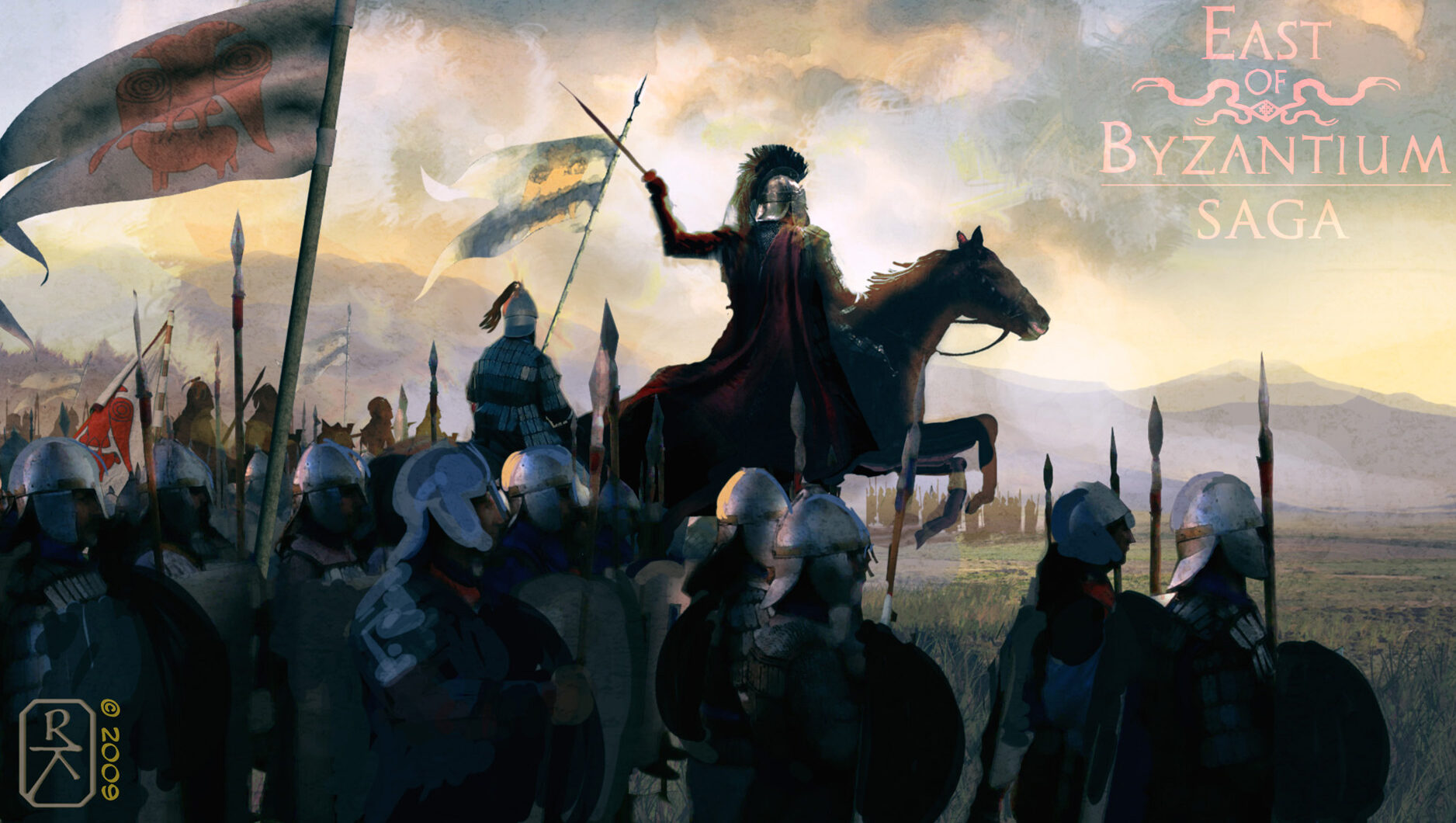
Pictured above: A fine modern illustration of Vartan leading his troops across the plain of Avarayr, from Roger Kupelian’s “East of Byzantium” saga.
One Comment