
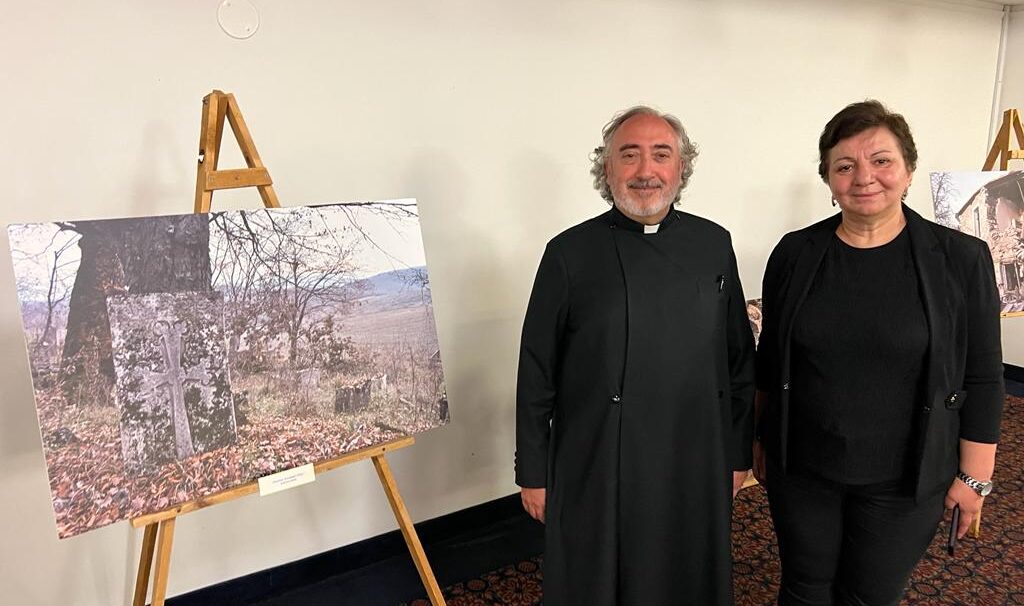
A passionately interested audience gathered on Thursday evening, May 26, at the Diocesan Center in New York, to view exquisite photographs of churches and villages in Artsakh, and hear from Dr. Marina Mchitarian, who had spent weeks in early 2020 visiting Artsakh and speaking with its inhabitants.
The subject of the exhibit, titled “Artsakh: Angel of Peace,” was embodied in two white statues of angles flanking the entryway to the Ghazanchetsots cathedral in Shushi, standing proudly at attention. Following the catastrophic invasion of Artsakh by Azerbaijan, almost 75 percent of this beloved territory has been occupied by hostile forces, while Armenian inhabitants in the 25 percent still under Armenian control are continually attacked. Azeri forces immediately went about dismantling treasured monuments of Armenian Christian culture. Reports and photos surfaced a year ago that the Ghazanchetstos cathedral itself–which was targeted and struck by an Azeri artillery rocket on October 8, 2020–has subsequently seen its steeple demolished.
The March 26 photo exhibit was sponsored by the Krikor and Clara Zohrab Information Center under the dedicated directorship of Dr. Jesse Arlen. Some attendees (this writer included) had visited this ancient and beautiful Armenian land; but many had come to learn more and see the display of unique photographs.
Opening the program, and introducing the speaker, Fr. Simeon Odabashian, Vicar of the Eastern Diocese of the Armenian Church of America, warmly welcomed the crowd and called Dr. Mchitarian “a heroine.” He stated that the “44-day war and the occupation of our beloved land has deeply affected all Armenians.”
Throughout her deeply emotional talk, accentuated by her passionate love for this ancient Armenian land with its picturesque landscape of mountains, greenery, waterfalls, lakes, churches, monasteries, and khatchkars, Dr. Mchitarian revealed that she had first visited Artsakh in 2007.
On her last trip there in 2020, she went to the holy Dadivank Monastery in Kelbajar—which the enemy had completely destroyed internally in the first Karabagh war of the 1990s. The experience turned out to be her “goodbye forever” trip, as the 2020 war started shortly after.
Artsakh: Our Identity
With Zohrab Information Center staff member Andrew Kayaian monitoring the video presentation, the speaker strongly declared “Artsakh is our identity, a symbol of the unity of the Armenian people.”
Two weeks before the war, the speaker had visited the students of Artsakh State University. A 19-year-old student after the war stated, “I dream of Artsakh rising from the ashes and blooming again.”
Dr. Mchitarian also visited many villagers in the highlands of Artsakh, with the blossoming symbolic pomegranate trees. She spoke to young and old who declared their undying love for their land. One grandfather stated through tears, “We will struggle until our last breath for this land.”
Of Armenian and Greek parentage, Dr. Mchitarian invoked the memory of the legendary Greek writer Nikos Kazantzakis, recalling the author’s quote about a pomegranate tree: “Sister, speak to me of Artsakh, and the pomegranate tree blossomed.”
Dr. Marina Mchitarian is the founding president of “Action for Peace,” an Armenian NGO. She received her Ph.D. in mathematics, then pursued doctoral studies in archeology in Greece and Belgium. Fluent in Armenian, Greek, Russian, and English, she worked for 15 years at the Mother See of Etchmiadzin, in the field of safeguarding cultural heritage. She has also worked for the Dutch NGO “Walk of Truth” at the Hague for three years.
Since February 2020, she has been an independent researcher investigating religious freedom, peace and reconciliation for the endangered Christians in the Middle East, and registered the NGO “Action for Peace” in Armenia where she conducted documentary photography projects in Artsakh in 2020 and 2021. She collaborates with the New York-based “Save Armenian Monuments.”
Save Armenian Monuments
Dr. Virginia Davies, founder of the “Save Armenian Monuments” foundation, and a member of “Women Startup Armenia,” also spoke at the event. Raised in Toronto, Canada, and now living In New York, she is the granddaughter of Armenian Genocide survivors.
Having visited Artsakh many times, she said that after the 1990 Karabagh war, “we Armenians forgot that more than a thousand religious monuments had to be restored, and villages needed rebuilding.”
“I restored a church in Artsakh, St. Minas in the Hak village of Kashatagh, in memory of my grandparents, who were both Genocide survivors. The village resonated with me because my grandfather was from a village in a mountainous region,” she said.
In Hak village, she and Dr. Mchitarian were involved in building schools, restoring the church, starting a water system, and increasing the number of cattle. “All is now gone, under occupation,” she declared tearfully, but we are not giving up.” She quoted the inspiring words of her grandmother who stated, “you will be honored by what you do.”
“Save Armenian Monuments” is dedicated to cleaning up churches, and building the needs of villages,” she said with passionate determination. “Our foundation demonstrates how we are as a people. “We have to work and save our people in Artsakh,” she declared, slowly emphasizing each word.
Following the inspirational talks, the crowd spent much time during the reception conversing with the speakers and viewing the unforgettable array of photographs taken by Dr. Mchitarian, including the meditative and iconic Dadivank Monastery, and the Ghazanchetsots Cathedral with its symbolic Angel of Peace statues.
Click here to view photos of the exhibit.
By Florence Avakian