
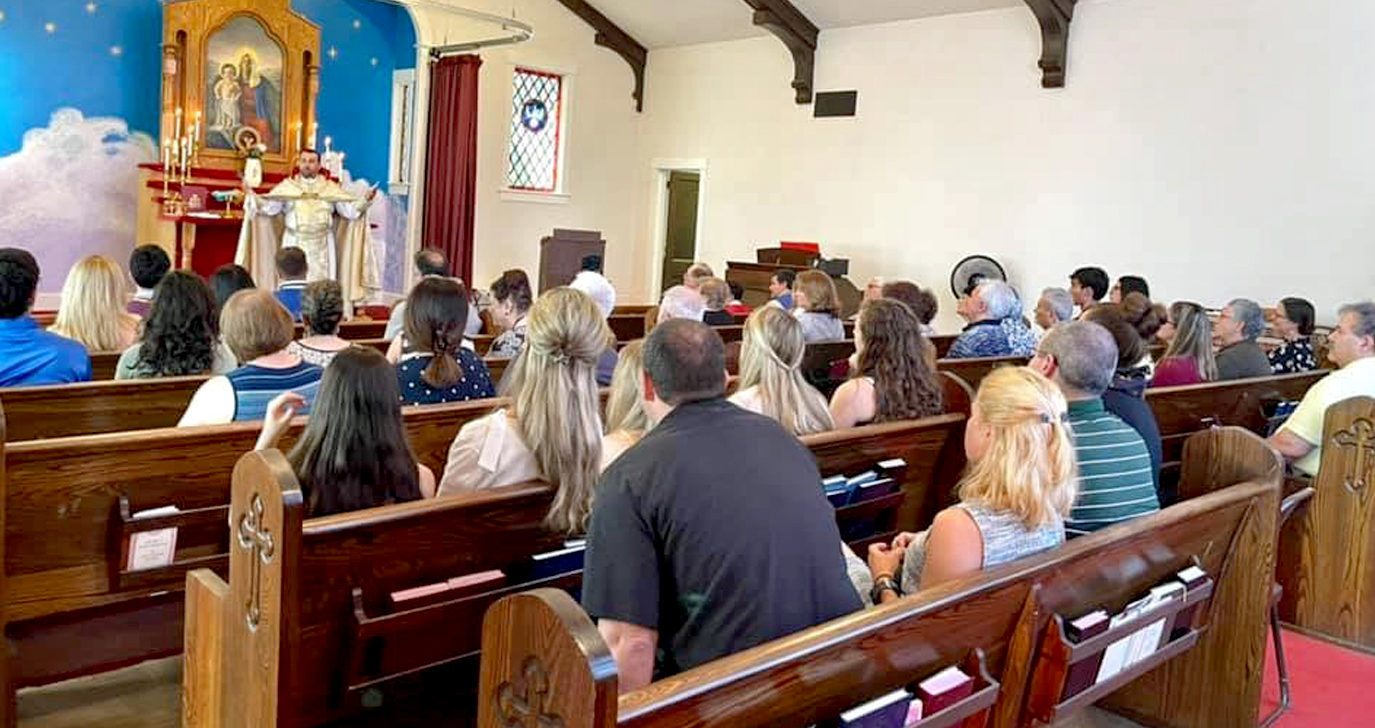
When an Armenian pastor took a family trip to Kansas City, MO, he found a new flock that was eager for his attention and care.
As the priest of St. Sahag Church in Minneapolis, MN, Fr. Tadeos Barseghyan had already brought a spirit of energy and excitement to a parish that had previously gone without fulltime pastoral leadership. But he had heard about a parish within driving distance of his home city that was struggling without a priest of its own.
“I drove with my family to Kansas City, and met with the wonderful Armenian community there,” recalls Fr. Barseghyan. “They taught me about their beloved St. Garabed Church, which was having services and gatherings only a few times a year. Listening to them, I made a commitment then and there to help the community.”
His commitment involves visiting the parish at least once every two months, to celebrate the badarak, tend to spiritual needs of the people, and otherwise bring them together in worship and Christian fellowship.
It’s a six-hour drive from Minneapolis to Kansas City, but Fr. Barseghyan is happy to undertake the journey. “It doesn’t feel right to me, knowing there is an Armenian parish only six hours away, that needs the guidance of a pastor,” he says. “How could I not reach out to help them?”
After his initial visit, he related these thoughts to Diocesan Primate Bishop Daniel—who was enthusiastic about giving the plan his blessing. Thus, Fr. Barseghyan was formally assigned as the visiting priest of St. Garabed Church.
Before taking that step, however, Fr. Barseghyan also wanted to discuss the matter with the parish council of St. Sahag Church, which would have to undertake a sacrifice of its own each time he visited Kansas City. However, the Minneapolis church was happy to encourage this expansion of their pastor’s ministry.
“My parishioners at St. Sahag recognized their own history in the situation at St. Garabed,” Fr. Tadeos says. “For many years, St. Sahag didn’t have a permanent pastor; every Sunday saw different clergy from our Diocese visiting the parish for badarak. The people were grateful for that; but the situation also made it challenging for the community to connect, and develop the structure needed for a fulltime parish.”
“Now, we are blessed to be in a position to reach out and help another parish in our Diocese,” he adds. In fact, the entire Minneapolis community is delighted to be helping a sister parish in this way.
Community Outreach
The first official visit to St. Garabed Church took place last June, when some 70 faithful Armenians from Kansas City turned out for the badarak and subsequent social gathering. It was the first live worship service for the community since before the pandemic, in November 2019.
“Since a large segment of the community are Russian speakers, I deliver the sermon in Russian as well,” explains Fr. Barseghyan, who like most natives of Armenia (he was born in the city of Etchmiadzin) is fluent in that language.
The most recent visit was in August. “I especially wanted to celebrate the Feast of the Assumption, and the Blessing of the Grapes, with the faithful in Kansas City,” he says. “We had around 70 people attending again. Among them are two new altar servers.”
Fr. Barseghyan takes his family along for each visit, and they assist him in the sanctuary as well as in his ministry to the parishioners. “For Assumption, I drove to Kansas City with my son Khachadour, who has been my assistant on the altar throughout the pandemic,” he says. Each visit also has time devoted to home blessings, visitations to the sick, and other needed pastoral functions.
But in addition to these sacred duties, Fr. Tadeos’ presence has brought the parish together in other ways. For example, Kansas City, MO, is home to the impressive National World War I Museum and Memorial. Recently, the priest and members of the St. Garabed parish council met with museum officials to discuss ways of properly introducing the Armenian Genocide among the exhibits.
“Currently, the museum has very little information on the subject,” he says, “with some inaccuracies in the main gallery display about the atrocities of the Armenian Genocide. A few references mention the ‘massacre’ of the Armenians, without properly calling it a Genocide; and the April 24 arrests of Armenian intellectuals goes unmentioned.”
The delegation from St. Garabed presented their thoughts and suggestions to the museum, which welcomed the exchanged and scheduled a follow-up meeting for October.
St. Garabed Church maintains an active Facebook page, where readers can learn more about its history and latest activities, and view photos of parish life and people.